Irish Gaelic Dialects: Munster, Connacht and Ulster Explained
When people talk about the Irish language, they often describe it as a single thing. Ask anyone in Dublin, Cork or Boston to “speak some Irish” and you will hear one version of it. But Gaeilge is far from uniform. Across Ireland, three distinct dialects have shaped the way the language sounds, bends its verbs and builds its sentences for centuries. For a learner, this is both a challenge and a gift: choosing one dialect gives you a clear target, a consistent accent and a community of speakers to model.
This guide explains the three living dialects of Irish Gaelic, where they are spoken, how they differ and how to pick the right one for your goals.
Why Irish Gaelic has three dialects
The short answer is geography and history. Ireland never developed a single, centralised spoken standard the way many larger nations did. Gaelic society was organised around local chieftains, monasteries and communities, each with its own patterns of speech. When the language was pushed to the western edges of the island during and after colonial rule, pockets of speakers survived in three main regions, and each region kept its own way of speaking.
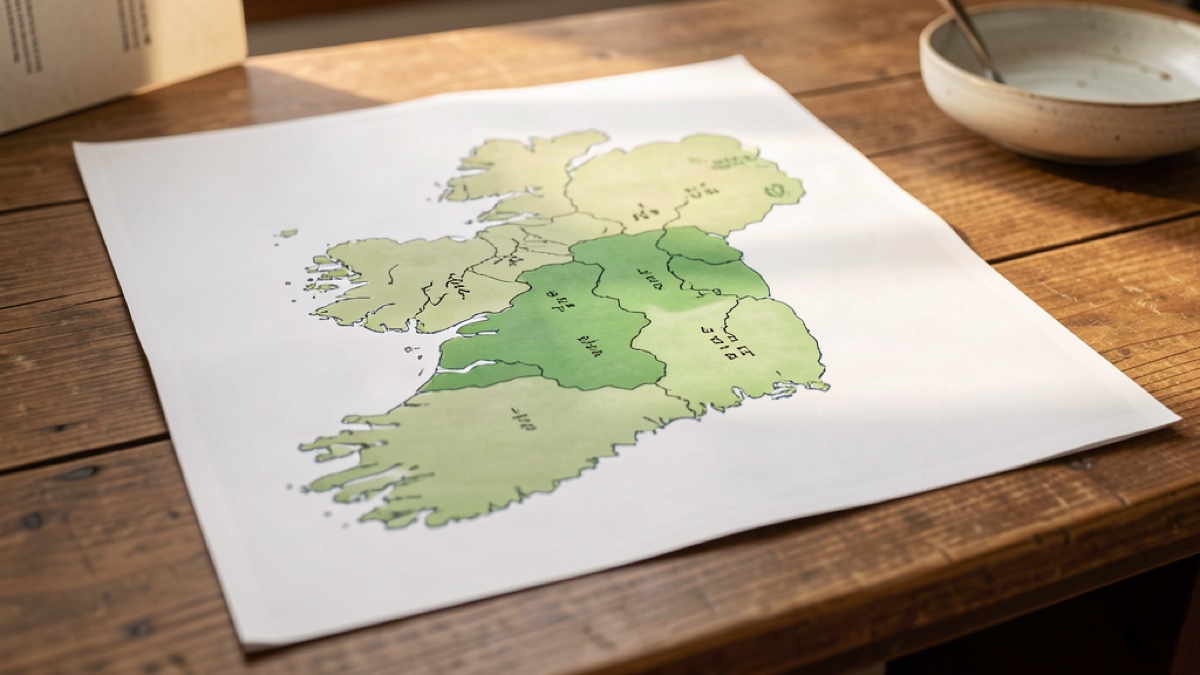
These surviving regions are called the Gaeltacht, the officially recognised Irish-speaking areas. The three main dialect blocs correspond to the historical provinces, and each has a distinctive identity:
- Munster Gaelic in the south, centred on Cork and Kerry.
- Connacht Gaelic in the west, centred on Galway and Mayo.
- Ulster Gaelic in the north, centred on Donegal.
There are also smaller pockets, such as the Connemara region within Connacht, which has become especially well known to learners. Standard Irish, which you will find in textbooks and apps, borrows elements from all three but is not itself a spoken dialect.
Munster Irish: the dialect of Kerry and Cork
Munster Irish is spoken in counties Kerry, Cork and Waterford, with the Corca Dhuibhne (Dingle) peninsula in Kerry being the most famous stronghold. It is often described as the most conservative of the dialects, preserving features that have faded elsewhere.
Pronunciation is one of its most recognisable traits. Where other dialects merge certain vowel sounds, Munster keeps them distinct. It also has a marked syllable stress pattern: in many words, the stress falls on the second syllable rather than the first, which gives the speech a distinctive, bouncy rhythm. Words you might stress on the first syllable in standard Irish are often stressed differently in Munster.
Grammar also sets it apart. Munster keeps a fuller set of verb endings, particularly in the present and past tenses, and it uses forms that learners from other regions may find unfamiliar. The famous phrase “Tá mé” (I am) can appear as “Táim” in Munster, a single-word form that sounds quite different.
For learners, Munster offers a rich literary tradition and a very clear, often slower-paced spoken style, helped by the fact that its features are well documented. If you want to understand the music of the language, Munster is a wonderful choice.
Connacht Irish: the Connemara standard
Connacht Irish, spoken mainly in Galway (especially Connemara) and Mayo, is the dialect that many learners meet first. Connemara has a Gaeltacht region that is relatively large and active, and it has produced a great deal of modern media, music and teaching material. As a result, Connacht has become a de facto teaching standard for many courses.
Its pronunciation sits between Munster and Ulster. It does not stress words as dramatically as Munster, and it does not have the very strong vowel shifts of Donegal. The Connemara accent is often described as clear and friendly, which is part of why so many online courses and podcasts use it.
In verbs, Connacht uses constructions that will look familiar to anyone who has studied standard Irish. It is a good “middle ground” dialect: if you are not sure which one to choose, Connacht is the safest bet because you will find the most teaching resources in it, and it is the dialect used in many Irish-medium schools and media outlets.
Ulster Irish: the dialect of Donegal
Ulster Irish, spoken in County Donegal in the far north, is the most distinctive of the three. For an English speaker it can sound the most surprising, because its pronunciation has shifted in ways that other dialects have not.
The vowels are the biggest difference. Ulster Irish has undergone changes that make certain words sound quite unlike their Munster or Connacht counterparts. The “a” sounds and the way consonants are released before vowels can sound almost like a different language to the untrained ear. The stress pattern also differs, and there is a strong, rhythmic quality that many find musical.
Ulster grammar has its own signature too. It dropped several of the older verb endings that Munster keeps, and it uses the present tense form in some places where other dialects use a different construction. There is also a noticeable influence from the Ulster Scots and English of the region, though the core grammar remains firmly Gaelic.
Ulster Irish is historically significant because it is closest to the form of the language spoken by the largest historic communities, and it has a strong presence in modern songwriting and Irish music from the north.
How the dialects compare at a glance
To see the differences in action, compare how each dialect says “I am”. In Munster you are likely to hear “táim” or “tá mé”, in Connacht “tá mé” is standard, and in Ulster you will hear “tá mé” but with a very different vowel colour. The same words can be written identically but sound remarkably different.
Verb endings are the clearest dividing line. Munster keeps endings that Ulster has dropped, so “to be” and the future tense conjugate with extra syllables in the south that simply disappear in the north. Whether a vowel is long or short, and whether a consonant is broad or slender, also varies by region.
Here is a practical point for new learners: you do not need to master all three. Pick one, learn its pronunciation and trust it. The dialects are mutually intelligible, and native speakers understand one another. The risk of “mixing” is mostly a beginner worry, and it fades as your ear develops.
Which Irish dialect should you learn?
Choose based on your resources and your goals rather than on which one “sounds best”. If you plan to visit or live in Ireland, pick the dialect of the region you will be in. If you want to listen to modern podcasts and watch new media, Connemara (Connacht) has the most output. If you love the musical, conservative forms of the language, Munster will reward you. If you are drawn to the distinctive northern sound and to Ulster culture, choose Donegal Irish.
Whatever you choose, the strategy is the same: expose yourself to that dialect consistently, in audio rather than only in text, and repeat. Your ears will adapt faster than you expect, and a clear single-dialect target beats a fuzzy mix of all three.
Common mistakes learners make across dialects
The most frequent mistake is trying to learn all three dialects at once. New learners hear a Munster word, a Donegal phrase and a Connacht pronunciation in the same week, then worry that they are “mixing”. In truth, native speakers routinely understand all three, and the confusion is temporary. Decide on one target, tell your tutor or app which dialect you want, and ignore the others until your ear is strong.
A second mistake is relying only on text. Pronunciation differences, especially the Munster stress pattern and the Ulster vowel shifts, are impossible to learn from a page. You have to hear them, which is why audio-first resources matter so much for any dialect you choose.
A third is treating standard Irish as if it were a spoken dialect. Standard Irish is a useful benchmark, used in most textbooks and the news, but no community actually speaks it as their everyday tongue. Master the standard as a starting point, then lean into the spoken forms of your chosen region. This gives you the best of both: a solid written base and an authentic accent.
Learn each dialect with targeted flashcards
The practical path to fluency is repetition, and the best repetition is the kind that fits a card system. Download FlashLearn on iOS to build custom decks of example sentences, verb forms and vocabulary in the dialect you have chosen. Drill the pronunciation patterns side by side, test your recall of the tricky syllable stresses, and watch your ear tune itself to one consistent accent.
The FlashLearn web app covers Scottish Gaelic, Irish and many other languages, so you can keep every deck you build in one place and review them on any device. Start with the verb endings of your chosen dialect, add real sentences from music and podcasts, and review a little every day. That consistent exposure, more than any single trick, is what finally makes one dialect feel like home.
The dialects of Irish Gaelic are not a barrier. They are a doorway into three rich traditions, each with its own music, its own literature and its own way of saying hello to the world. Choose the one that calls to you, and start listening.