
Irish folklore and mythology: the legends and creatures every learner should know
Ireland’s mythology is one of the richest storytelling traditions in Europe, and it is far more than a collection of old fairy tales. Its cycles of epic battle, tragic transformation and sharp humour shaped how the Irish understood their land, their identity and their language. For anyone learning Irish Gaelic, these stories carry a double reward: they are unforgettable in their own right, and they explain why so many everyday Irish words carry echoes of gods, warriors and spirits. This article explores the main cycles of Irish mythology, the creatures that haunt its margins, and the way the tradition still lives on in modern Irish speech.
The Tuatha Dé Danann and the origins of Irish myth
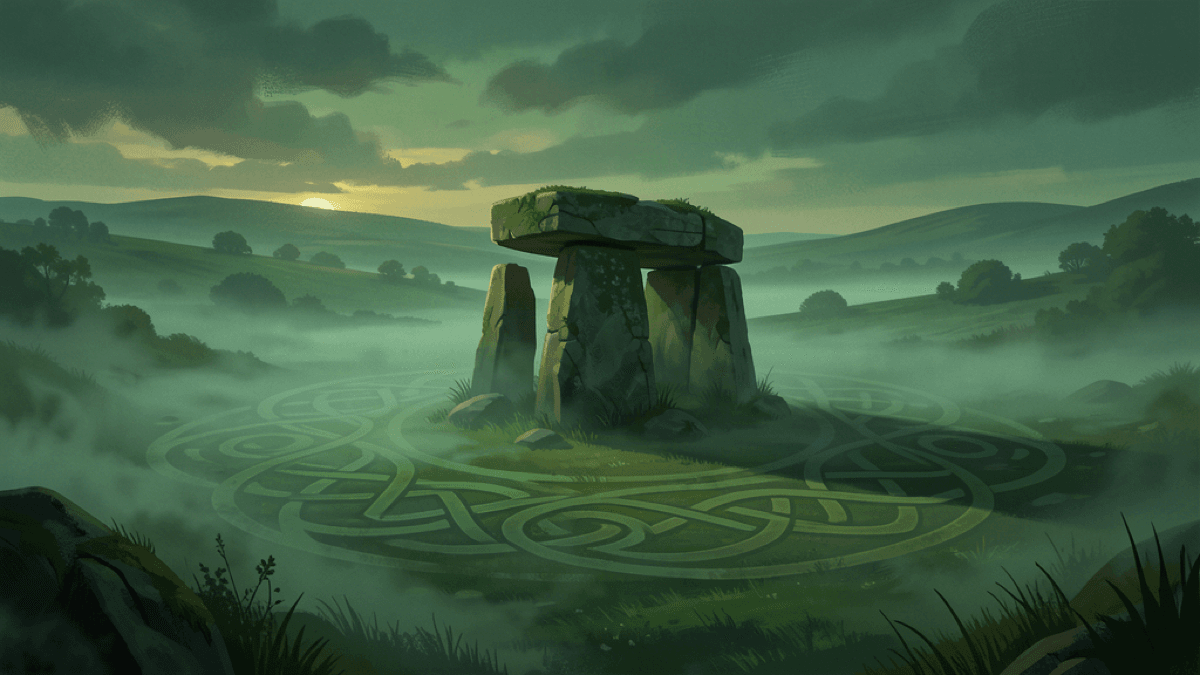
At the centre of Irish mythology stands the Tuatha Dé Danann, whose name means “the tribes of the goddess Danu”. These were not gods in the distant sense of a hidden pantheon, but a supernatural people who arrived in Ireland in a series of legendary invasions. Their story is told in the Leabhar Gabhála, or “Book of Invasions”, a medieval compilation that records wave after wave of settlers, from the first peoples to the final conquest by the Milesians.
The Tuatha Dé Danann brought with them the great treasures of myth: the Lia Fáil, the “Stone of Destiny”, which roared under the rightful king; the Claíomh Solais, the “Sword of Light”; the Slea an aghaíte, the “Spear of Lug”; and the Coire an dágha, the “Cauldron of the Dagda”, which could feed any number of guests. These four treasures became famous around the world when they were reimagined in modern fantasy, yet they are thoroughly Irish in origin. For the learner, the names themselves are a first lesson in Irish structure, since particles such as an (the) and na (of the) appear constantly across the tradition. To understand the Tuatha Dé Danann is to understand how the Irish imagined their own prehistory, weaving geography, genealogy and language into a single founding narrative.
The four great cycles of Irish mythology
Scholars have long divided Irish mythology into four broad cycles, each with its own cast, landscape and mood. The division is a convenience rather than a strict rule, and the cycles overlap and borrow from one another, but it remains the clearest map for a newcomer.
| Cycle | Notable figure or text | Main concern |
|---|---|---|
| Mythological Cycle | Tuatha Dé Danann, Leabhar Gabhála | Origins, invasions, the gods, the Otherworld |
| Ulster Cycle | Cú Chulainn, Táin Bó Cúailnge | Heroic warriors, the Red Branch of Ulster |
| Fenian Cycle | The fianna, Fionn mac Cumhaill | A legendary warrior band and its adventures |
| Historical Cycle | The kings of Tara | Legendary kings, dynasties, the high-kingship |
The Mythological Cycle, linked to the Tuatha Dé Danann, is the oldest in theme and deals with creation, settlement, and the gods who withdrew into fairy mounds. The Ulster Cycle centres on the province of Ulster and its hero Cú Chulainn, whose feats are told in the great epic the Táin Bó Cúailnge, the “Cattle Raid of Cooley”. The Fenian Cycle follows the fianna, a band of warriors led by Fionn mac Cumhaill, and is rich in romantic quests and long exiles. The Historical Cycle turns to mortal kings, the high-kingship of Tara, and the genealogies that connect myth to the royal houses. Together the four cycles give a learner a complete architecture of Irish storytelling.
The Children of Lir: a tragedy of the sea
Few tales are more moving than that of the Clann Lir, or “Children of Lir”. According to the legend, the sea god Lir had four children, a daughter and three sons, who were turned into swans by the jealousy of their stepmother. The enchantment was cruel in its precision: they would keep their human hearts and their beautiful voices, but they would spend nine hundred years as birds, forced to wander the lakes and seas of Ireland. Only the ringing of a Christian bell, in the distant future, would break the spell.
Throughout those centuries the swans sang haunting songs that comforted every listener on the water, and their story became a national parable of endurance and patience. For language learners the tale is especially useful because it appears in simplified retellings and in song, offering gentle Irish vocabulary for family, the seasons and the natural world. The story reminds us that in Irish myth the border between human and animal was always thin. The Children of Lir endures because it is a tragedy, not a triumph, and the Irish tradition has always made space for sorrow alongside heroism.
Courtship and heroism: the Wooing of Étaín and Cú Chulainn
Two tales illustrate the literary richness of Irish myth at its most refined: the Tochmarc Étaín, or “Wooing of Étaín”, and the exploits of Cú Chulainn, the great hero of the Ulster Cycle. The Wooing of Étaín tells how the warrior Midir fell in love with Étaín, a woman of such beauty that the gods wished to keep her for themselves. To win her, Midir had to discover which of several women was the true Étaín, a riddle that unfolds across the Otherworld and tests his perception as much as his strength.
Cú Chulainn, whose name is often read to mean “the hound of Culann”, is the central figure of the Táin Bó Cúailnge, and his rage and grief anchor the Ulster Cycle. His battle fury, his connection to the land and his doomed love made him the template for countless later heroes. Where the Wooing of Étaín is subtle and romantic, the tales of Cú Chulainn are violent and grand, yet both share the Irish genius for blending the mythical with the human. Reading them side by side shows a learner that Irish literature worked in many registers, from courtly romance to bloody epic.
The Banshee: an fear bean sí
Of all Irish supernatural figures, the bean sí (banshee) is among the most feared and the most misunderstood. The name means “woman of the sí”, the sí being the fairy mounds or the Otherworld, and the bean sí is a female spirit whose wailing, or caointe (keening), foretells death. In older tradition she was not a monster but a guardian of certain families, often the descendant of a great house, who lamented when one of her kin was about to die. Her cry echoes the traditional mourning song of Irish funerals, so that the supernatural and the ordinary grief of a community were woven together.
Modern popular culture tends to portray the bean sí as a screaming horror figure, but in the folklore she is more sorrowful than sinister, a voice of fate rather than a bringer of harm. Some accounts describe her as a young woman with long hair, others as an old crone, and she might appear combing her hair near a river. For the learner, the word bean sí is a perfect window into Irish grammar, since it combines bean (woman) with the genitive sí (of the mounds). Understanding her is not just a matter of knowing a monster, but of seeing how deeply death, memory and place were twinned in the Irish imagination.
The leprechaun: old lore and modern stereotype
No Irish creature is more famous than the leipreachán, and none has been more distorted by tourism and cartoon imagery. The modern leprechaun, a small smiling figure in a green suit guarding a pot of gold, is a recent invention, largely exported by writers and advertisers in the nineteenth and twentieth centuries. The older tradition described a far trickier being: a solitary fairy shoemaker, often clothed in red, who was cunning, grumpy and quick to vanish. His name comes from the Irish leipreachán, and his chief fame lay in his hoard of gold, which he would never reveal willingly.
The stereotype matters because it replaced a complex figure with a national mascot, and Irish writers have long pushed back against the “Plastic Paddy” caricature. Yet the underlying folk spirit survives, and the leipreachán remains genuinely Irish in origin even if his modern uniform is not. For the learner, the lesson is to look past the souvenir-shop image and recover the older lore, in which the leipreachán was respected more than loved, a reminder that the Irish supernatural was never safe or sentimental. The contrast between the old trickster and the modern mascot is a small case study in how folklore adapts, and sometimes diminishes, as it travels.
Irish mythology lives on in the language
The deepest connection in this whole tradition is the one between myth and language. Many words in daily use carry mythological weight without most speakers noticing. The toast Slán, which means “health”, comes from the old Irish word for well-being, and it is heard across Ireland and the diaspora as readily as any English greeting. Readers sometimes assume the word craic is native Irish, but it is not: craic was borrowed into Irish from English “crack” via Ulster Scots, and the Irish spelling simply gives the loanword a Gaelic face. It is a vivid warning against assuming that every Irish-looking word is ancient.
Other terms point straight back to the Otherworld. The sí gives English the word “sidhe” and stands behind the bean sí, while the púca, a shape-shifting spirit, survives in the modern “pooka”. Words such as seanchaí, an older term connected with the fairy host, remind learners that the countryside was once thick with named spirits, each with its own territory and temper. Learning these words does not mean memorising a dead myth; it means discovering why Irish speakers still use a rich vocabulary of wonder, grief, caution and luck in ordinary conversation. Anyone curious about how this ties into how the language is actually spoken today can start with a guide to the Gaeltacht regions, where these traditions remain most alive, or begin with Irish Gaelic for beginners. The same imaginative world flows north across the water, as the folklore and mythology of the Scottish Highlands shows, since Scotland and Ireland share a common Gaelic inheritance.
The four cycles, the tragic swans of Lir, the riddle of Étaín, the fury of Cú Chulainn, the keening of the bean sí and the double nature of the leipreachán all speak to one truth: Irish mythology is a living thing, not a museum piece. It survives because the language carries it, and the language survives because these stories give it heart. For the learner, every chapter of this tradition is an invitation to go deeper, to learn the words behind the names, and to hear in an everyday greeting like Slán the long echo of a culture that never quite let its gods go.
1 Comment
Comments are closed.
[…] and reimagined in modern Gaelic communities, and they appear again and again in songs, stories, and folklore across the Gaelic world. For the learner, they offer a perfectly spaced annual syllabus: one […]