Irish Gaelic Weather Words: Rain, Wind and Sky Vocabulary
The weather is not mere small talk in Ireland. It is the shared thread of nearly every conversation, the first thing said at a doorway, and something close to a national hobby. That is why Irish Gaelic weather words are the single most useful vocabulary set a learner can build. They appear in every real exchange from the very first day, and to talk about rain, wind, sun, and sky in Irish is to hold a genuine welcome conversation anywhere on the island. Best of all, this vocabulary is logical and warm, regular in its grammar and evocative enough to stick in memory.
Why Weather Words Are the Perfect First Vocabulary
The chief advantage of weather vocabulary is that it is both simple and endlessly reused. Ten words carry a learner into real exchanges without months of grammatical preparation. Rain, sun, and wind are concrete nouns that attach easily to the everyday verbs a beginner already knows. Because the same words feed greetings, small talk, forecasts, and proverbs, they multiply in usefulness faster than almost any other topic.
Weather words also offer steady pronunciation practice. Irish Gaelic carries sounds that do not exist in English, and weather terms happen to repeat the most common ones: slender consonants, the broad and narrow vowel pairs, and the distinctive sibilants. Saying báisteach correctly teaches the sound clusters that run through the entire language.
There is a deeper reason this vocabulary works so well: the words are emotionally loaded. Rain in Ireland is not neutral. It is a companion, a shared complaint, and a point of pride, and a word that carries feeling is a word the memory keeps. That is why speakers of all generations build so much social language around the sky above them, just as in the everyday Gaelic phrases they learned first.
Rain: The National Word
Rain is the beating heart of Irish weather vocabulary, and no word matters more than báisteach (pronounced roughly bawsh-takh). It comes from the verb báistigh, meaning to rain or to shower. For a heavier fall, clagarnach and stealladh báistí describe a lashing downpour. A persistent soft drizzle is called ceobhrán, a word whose gentle sound suits its meaning, and the finer grades of rain run from mionbháisteach to the understated braon báistí, “a drop of rain.”
The essential construction for talking about rain is striking: tá sé ag cur báistí (pronounced roughly taw shay egg kur bawsh-tee), literally “it is putting rain,” the ordinary Irish way of saying “it is raining.” The verb cuir, to put or to send, appears throughout weather speech, because Irish speakers put rain, snow, and wind onto the land. Tá sé ag cur sneachta means “it is snowing.” Tá sé ag cur seaca means “it is freezing.” Master the pattern of ag cur followed by the weather noun and the whole family of statements falls into place.
When the rain stops, people say tá an bháisteach thart, “the rain is over.”
Wind and the Sky
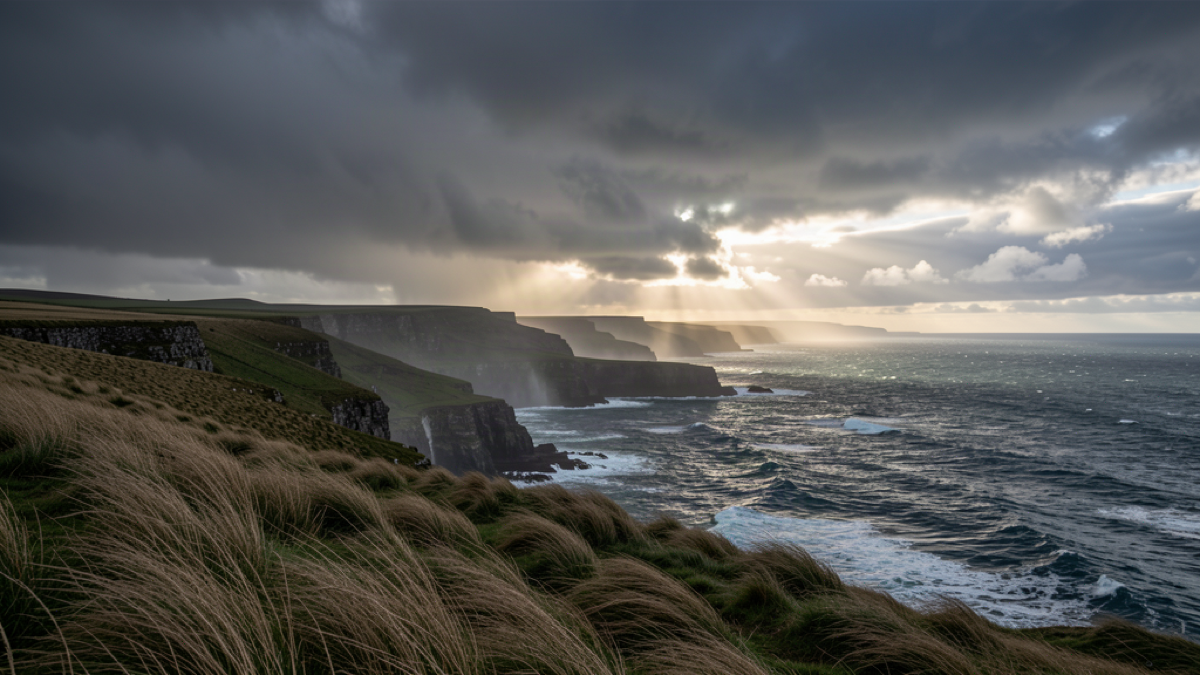
Wind in Irish is gaoth (pronounced roughly gwee), and the word also names a sea inlet, a reminder that the old language keeps the landscape woven into daily speech. A windy day is lá gaofar, and gusts are gaotha. When the wind is strong, people say tá gaoth láidir ann, “there is a strong wind.” The calm air after wind is ciúnas.
The sky is spéir (pronounced roughly spay-r), a feminine noun found in one of the loveliest stock phrases, scamaill sa spéir, “clouds in the sky.” Lá spéiriúil is a bright, clear day. When the clouds break, glan scamaill, “clear the clouds,” captures the moment the light returns. Fog is ceo (pronounced roughly kyoh), and ceobhránach describes the clinging mist. Taise is dampness, and the verb fliuch, to wet, produces the common phrase tá sé ag fliuchadh, “it is getting wet.” The low gray that sits on the western hills is never far from any Irish speaker’s vocabulary.
Sun, Heat and the Good Day
The sun is grian (pronounced roughly gree-an), a feminine noun shared across the Gaelic world. Warmth is te, as in tá sé te inniu, “it is warm today,” and te yields téamh for the act of warming, so an ghrian ag téamh an lae is the sun warming the day. Lá grianmhar means a sunny day. To announce the sun, people say tá an ghrian amuigh, “the sun is out,” with the mild surprise of speakers used to cloud.
Heat in Irish separates into degrees English often collapses. Te means warm, which in this damp climate is usually the relevant degree, while the stronger word for hot is teith. Still, because Ireland rarely turns truly hot, most speakers reach for the intensifying prefix an-, so an-te, “very warm,” covers most summer talk. The prefix is one of the most productive patterns in the language: an-bháisteach is a huge downpour, an-fhuar is freezing, and an-mhaith is very good.
A fine day draws on breá, as in lá breá, “a splendid day.” The real mark of happiness in weather talk is the compound lá maith, “a good day,” reserved for a day that behaved itself.
Cold, Fog and a Soft Day
Cold weather centers on fuar (pronounced roughly foo-ar), an adjective that also serves as a noun for the cold. Tá sé fuar inniu, “it is cold today,” is among the first full sentences any learner should own. The chill you feel is expressed as tá fuacht orm, “cold is on me.” Frost is sioc, and a frosty start to the day is siocúil, while lá seaca describes a day of frost. The damp cold of the Irish winter is not a deep freeze; it is the creeping taise of fog and sea mist, which is why lá bog matters so much.
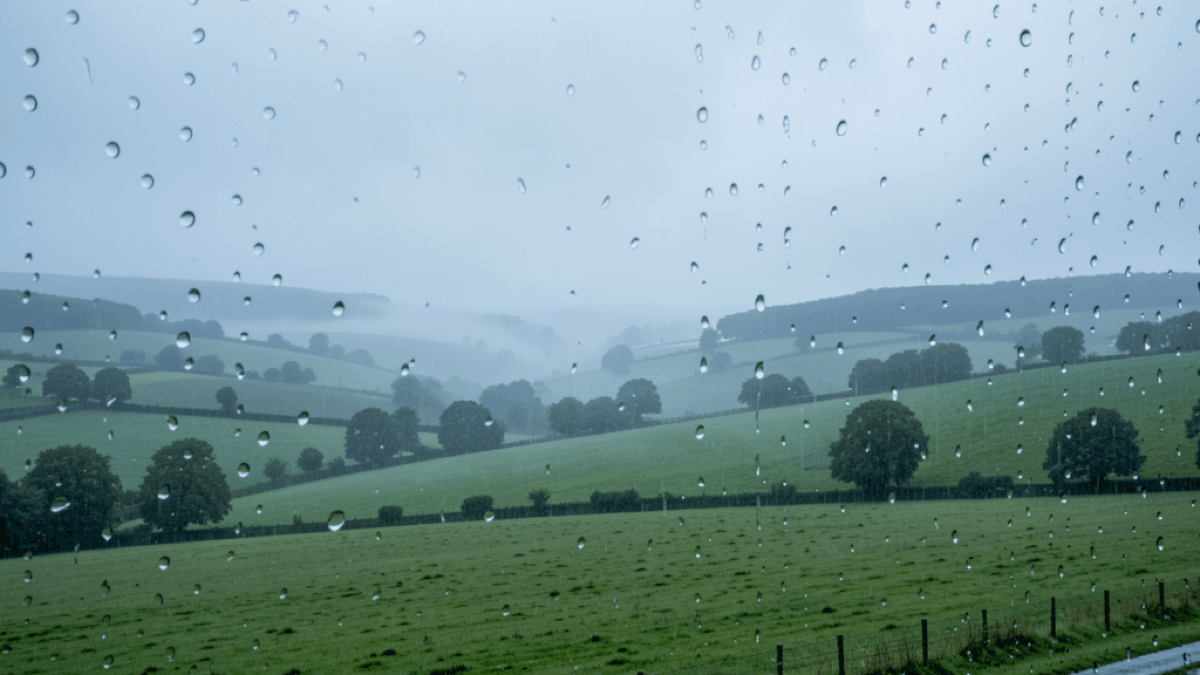
Lá bog (pronounced roughly law bog) literally translates as “a soft day,” and in Ireland it describes the gentlest, most beloved kind of weather. A soft day is a drizzly one, where rain falls too fine to be called a downpour, and the air hangs thick and gray with a pearled light. The cloud neither storms nor clears; it simply envelops. When someone says tá sé bog inniu, “it is soft today,” everyone nearby understands the wry, affectionate observation, and the phrase captures a national temperament better than any textbook. Those who go on to study the Irish Gaeltacht regions will hear it spoken constantly.
The Irish Drizzle: A Soft Day
The soft day deserves its own close look because it rules the Irish calendar. In the west and southwest, where the Atlantic pushes cloud after cloud ashore, a genuinely soaking downpour is rarer than ceobhrán, that fine mist that hangs for hours without ever deciding to rain. The language was shaped by this weather, and the words for fine rain carry a loving precision.
Ceobhrán is the drizzling mist itself. Mion- serves as a prefix meaning small or fine, giving mionbháisteach for fine rain. Braon means a drop, and braon báistí, “a drop of rain,” is the signature understatement for weather that is often quite wet indeed. The verb for drizzling is ag brobhsaíl, whose soft consonants echo the soft day.
This vocabulary of understatement is central to Irish social speech. Where English complains, Irish softens toward the poetic. A day described as fliuch go leor, “wet enough,” can mean water dripping from every hedge, and the humor lives in the gap between the literal words and their real weight. When the sky is threatening rain, people say tá sé ag bagairt báistí, “it is threatening rain.” When it starts, the announcement is tá sé ag tosú ag cur báistí, “it is starting to rain.”
Weather in a Full Conversation
Weather phrases slide naturally into whole exchanges rather than standing alone. A typical dialogue opens with the greeting dia duit, “God to you,” and turns at once to the day. The standard question is conas atá an aimsir inniu? meaning “how is the weather today?” aimsir is the everyday word for weather. A reply may say tá sé ag cur fearthainne, “it is raining,” using fearthainn, a slightly more formal synonym for báisteach, or tá sé ag stealladh, “it is pouring,” from steall, to pour. The exchange closes with a parting like slán leat, “safety with you.”
These layers matter because learners hear several words for the same weather and wonder which to prefer. In daily speech the shortest and most common form wins, with báisteach as the everyday default while fearthainn belongs to more formal or literary settings. Knowing both lets the learner move between registers with confidence, and the weather question becomes a natural preface to fuller conversation.
Weather Words Across the Gaelic Family
Irish Gaelic does not carry its weather vocabulary alone. The Gaelic family, including Scottish Gaelic and Manx, shares a deep inheritance. The Scottish Gaelic word for rain is uisge, a cousin that also gives the English word whisky through its original “water of life”. The sun is grian in both languages, and the sky is speur in Scottish Gaelic, close to the Irish spéir. Learners who start with Irish and move across the family will find the ground more familiar than expected: the soft day exists in Scottish Gaelic too, and the same gentle, affectionate register of weather talk runs through the whole Gaelic world. For the sister language, Scottish Gaelic weather words cover the same ground from the other side of the water.
Because the family spans regions, weather vocabulary also reveals how dialect shapes daily life. A Connemara speaker and a Donegal speaker may reach for different words for the same downpour, yet both instantly understand a conversation about a soft day. This shared backbone makes weather a bridge rather than a boundary.
How to Learn Weather Vocabulary
The most effective method is to live inside the words. Begin each study session by looking out a window and naming the weather aloud in three short sentences. Repetition tied to real observation anchors the vocabulary to experience with a strength flashcard drilling alone cannot match.
Pair each noun with its adjective and its verbal phrase. Learn báisteach, then báisteach mhór for heavy rain, then tá sé ag cur báistí for the sentence. Clustering words into families makes them memorable because the connections carry the memory. Pronunciation matters more than list length, and the slender consonant clusters in words like báisteach collapse if rushed. Build a simple weather journal for a week, writing one line per day, which forces recall and builds the genitive forms at the same time.
Finally, listen to native speakers. Weather talk is among the most common content in Irish radio, podcasts, and daily media, because it is the one thing everyone shares. Pay attention to the rhythm of a sentence like tá sé fuar amuigh, “it is cold outside,” and imitate its musicality rather than just its meaning.
Conclusion
Irish Gaelic weather words open the friendliest door into real conversation, combining simplicity, daily use, and deep emotion. From báisteach and gaoth to the beloved lá bog, these words let a learner speak from the first week and keep speaking for years. Master the rain, and the rest of the sky becomes familiar.