Scottish Gaelic Weather: Words and Phrases for Rain, Sun and Sky
In Scotland the weather is not small talk, it is the national backdrop, and every learner quickly discovers why it dominates conversation. Ask a Gaelic speaker how the day is going and the answer usually begins with the sky. That makes weather one of the most practical topics you can master early, not just for the vocabulary itself but because it gives you a natural reason to speak every single day. This guide covers the essential Scottish Gaelic weather nouns, the sentence patterns you need to describe the sky, and the phrases locals actually use, with the exact resources where you can hear them spoken.
Weather vocabulary is also a doorway into the wider grammar of the language. Describing what is happening outside uses the same structures you will later use for daily life, so the time you invest here pays off across every other topic in your studies.
Why weather vocabulary matters in Scottish Gaelic
The practical case is simple: weather is the most frequent topic of everyday Gaelic conversation. From the farm towns of the Western Isles to the bus routes of Glasgow, a comment about the rain or the wind opens more natural exchanges than almost anything else. If you are learning through modern resources like LearnGaelic and BBC series, you will notice that the very first lessons lean on weather precisely because it is so useful.
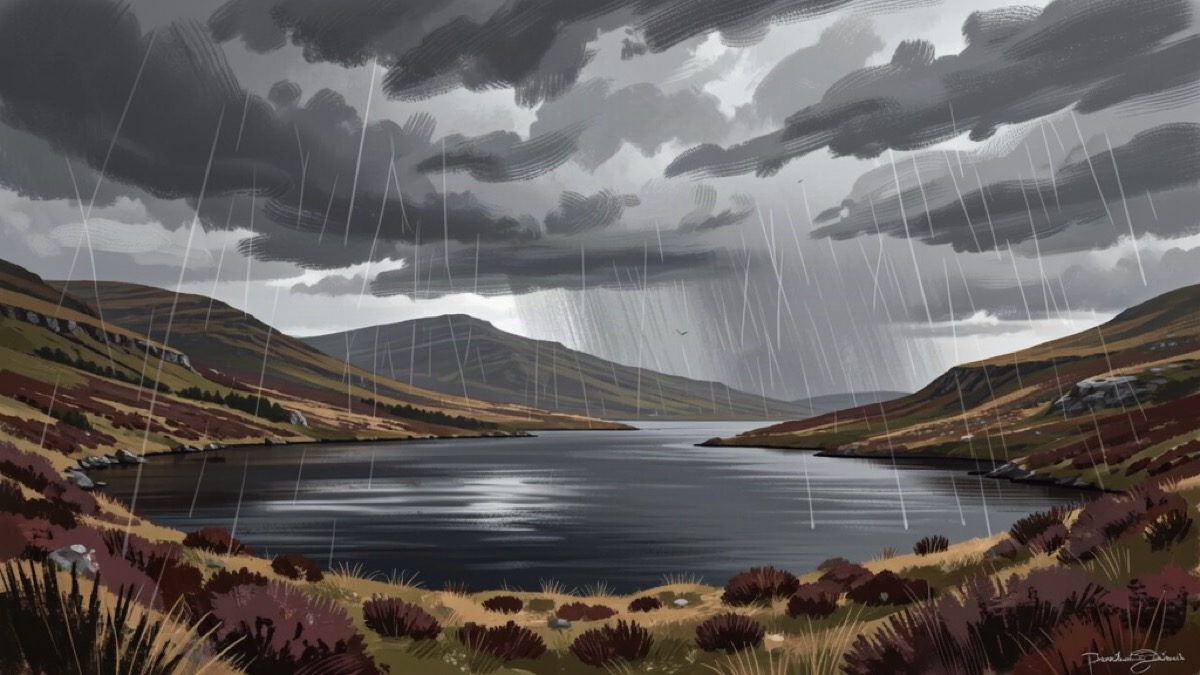
There is also a cultural reason. Scotland’s landscape has been shaped by its Atlantic climate, and the Gaelic language carries that history inside its place names. Words like loch, beinn and gleann describe the geography that weather made, and once you recognise the patterns behind them you start reading ordinary place names as meaning. Weather talk is where the language, the land and daily life all meet. If you are new to the language, pair this topic with our complete beginner’s guide to Scottish Gaelic to anchor the basics before adding vocabulary.
Essential nouns for the weather
The most useful place to start is a handful of core nouns. In Scottish Gaelic, grammar changes the shape of these words depending on how they are used, so it helps to learn them inside short phrases rather than as isolated dictionary entries:
- Weather itself is aimsir, and you will hear it constantly in greetings.
- Snow is sneachd, one of the first words many learners pick up.
- Wind is gaoth in modern spelling, with the older gàoth still appearing in older texts.
- Sea and loch, muir and loch, anchor the coastal vocabulary you meet in place names.
- Water is uisge, the root of countless river and town names.
The landscape words deserve special attention because they appear everywhere in Scottish geography. A beinn is a mountain, a gleann is a valley, and a srath is a wide river valley, which is why you see the same roots repeated across the map. Once you know a handful of these, the whole country starts to look different.
For the audio side of these words, see our Scottish Gaelic pronunciation guide, and for the full current word list with recordings, the best companion is LearnGaelic, whose weather section pairs every term with a sound file so you can match the written form to the spoken form.
Describing what the weather is doing
To move from a list of nouns to actual sentences, you need the patterns Gaelic uses for description. Gaelic likes to state that something is, and the structure is built around small, reliable phrases that you can reuse.
The simplest way to say what something is like is to use the construction that places the subject first: a sentence such as the word for weather followed by a description. Gaelic often expresses the idea of “it is raining” or “it is cold” through impersonal forms, which means you are not naming a person who does the raining, you are simply stating the state of the world. This is one of the first places learners notice how different Gaelic logic is from English, because you stop asking who is doing the action and simply describe what is happening.
A very practical habit is to learn weather as formula sentences. When you practise saying “the snow is heavy” and “there is frost this morning”, you are drilling the exact skeleton you will later use for dozens of other topics. That is why the best study method for weather is not rote vocabulary but building a small set of sentence patterns and saying them aloud until they feel automatic.
A reliable way to check yourself is to describe the same scene three ways in one day: in the morning, at noon and in the evening. Because the state of the sky changes, you are forced to reach for different words and verb forms, and repetition across a real day imprints the patterns far better than a single study session ever could. Even a two-line journal entry in Gaelic, written in the notes app of your phone, is enough to build this habit.
Common weather phrases and idioms
Beyond the literal vocabulary, Gaelic is rich in weather expressions that locals lean on. Because the language developed in communities that watched the sky closely, many idioms use weather to talk about moods, effort and luck. A phrase about cold describing a person, or a saying about the wind meaning a difficult journey, are the kind of colour that makes your Gaelic sound natural rather than textbook.
As with any idiomatic language, you want to hear these in context before repeating them. Watching Gaelic weather broadcasts or the culture segments on BBC Alba gives you real examples of how tone of voice matches the literal meaning. This is where immersion matters: the literal translation rarely captures how the phrase actually lands.
It helps to collect these expressions exactly as you would words. Keep a running note titled with the date and write down every new weather phrase you hear, whether from a programme, a podcast or a conversation. When you return to the list a few days later and reuse the phrases aloud, you turn passive encounters into active vocabulary, which is the same mechanism that makes immersion practice so effective for learners at every level.
Talking about the seasons and climate
The four seasons give you a natural framework for organising weather vocabulary. Each season brings its own set of words, from the short days and frosts of winter to the long light of summer. Gaelic has specific ways of referring to the seasons as times of year, and these appear constantly in conversation about plans, travel and work.
Learning weather by season is also an excellent memory hook. When you attach a set of rain words to autumn and a set of snow words to winter, each season becomes its own little chapter, which makes recall far easier than a flat list. For a structured approach, the beginner courses on LearnGaelic and BBC Bitesize present exactly this kind of seasonal progression with accompanying audio exercises.
As you learn the seasons, notice how they mix with the time words you already know. Asking what season this is, when a festival falls or what month an event is in, naturally folds weather into the wider sense of the year. Building those bridges early is precisely what the festival and seasonal vocabulary material on this site develops further, tying the calendar and the climate together.
How to build weather with an adjective
The single most useful pattern in weather talk is combining a noun with a describing word. Gaelic slots adjectives into a clear position, and once you have that order in your hands you can describe almost anything outside, not just the few words you happen to have memorised.
Practise by swapping the describing word while keeping the noun fixed: a heavy snow, a strong wind, a cold sea. Then swap the noun while keeping the description fixed: a cold sea, a cold morning, a cold house. Each time you do this you are internalising the word order without memorising full sentences one by one. Traditional flashcards are perfect for this kind of drilling, which is why spaced repetition works so well for language vocabulary in general.
Practising weather words with spaced repetition
Because weather vocabulary is small and extremely high frequency, it is an ideal target for spaced repetition review. A short daily session where you test yourself on the aimsir words returns more value than an occasional long session, because the whole point is that you meet these words constantly in real conversation.
A simple plan works well: learn the core nouns and landscape words first, then add one sentence pattern each week, and always practise aloud. Say the weather outside your window every morning in Gaelic, even if you only manage one sentence. This single habit, tested hundreds of times by learners, is the fastest route from knowing a word to producing it without thinking. As you build a daily routine, you will find that weather is the perfect warm-up exercise for every other part of your Gaelic practice. Need help turning that into a schedule? Our guide to creating a daily routine for learning Scottish Gaelic walks through the exact steps. When you are ready to drill the vocabulary on the go, try the Flaaash web app for flashcard practice on any device.
Start practising today
Turn the vocabulary from this guide into daily review with FlashLearn and the Flaaash web app.