Gaelic-Medium Education in Scotland: How Schools Are Reviving the Language
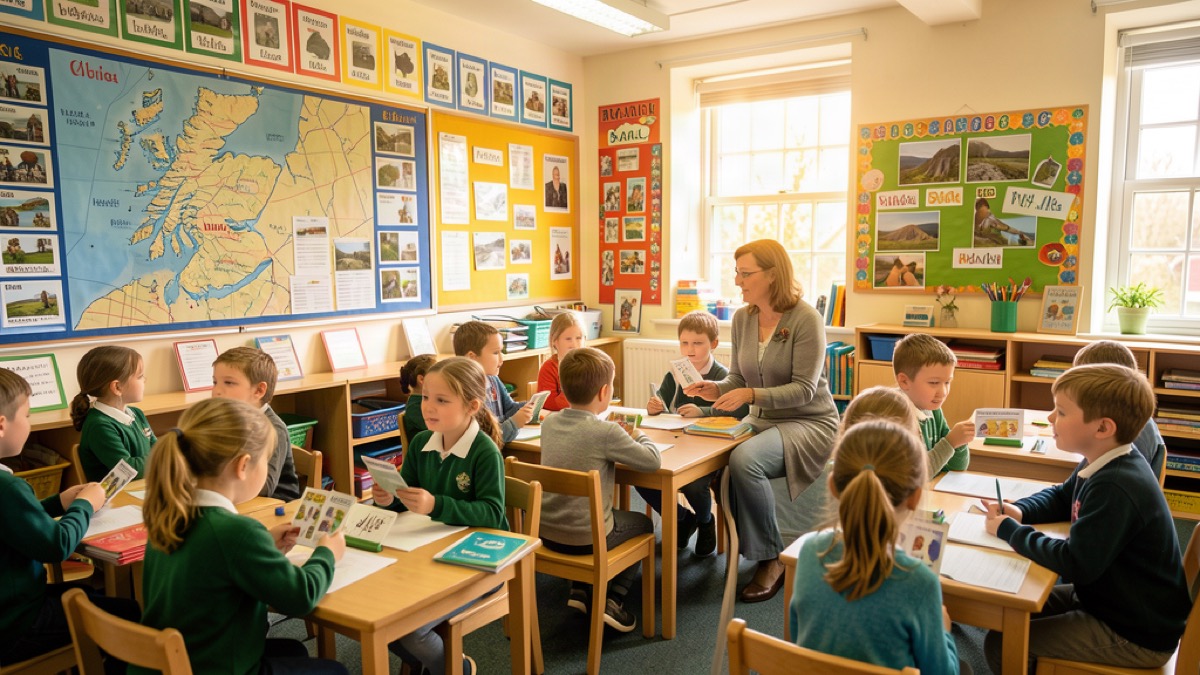
Of all the strategies used to revive Scottish Gaelic, few are more powerful or more debated than Gaelic-medium education (GME). In a Gaelic-medium school, children learn almost entirely through the language from nursery and primary school onward, not as a subject but as the medium of daily instruction. The results are remarkable: pupils emerge fluent, and demand for places now regularly outstrips supply.
For anyone learning Scottish Gaelic, or supporting a family member who is, understanding how GME works matters. It explains where fluent young speakers come from, why the language is growing in the cities even as the traditional heartlands decline, and how you can plug into a system that produces genuinely bilingual children. This guide explains the structure, the evidence, and how families and learners can get involved.
What Gaelic-Medium Education Actually Is
Gaelic-medium education is immersion. From age three in some nurseries, and from Primary 1 in schools, children are taught in Gaelic. Teachers speak Gaelic, lessons are conducted in Gaelic, and the social life of the classroom happens in Gaelic. English is introduced fully as a formal subject only around the middle of primary school, by which point the children have strong Gaelic foundations.
Crucially, the goal of GME is not to erase English but to produce bilingual children. The approach is additive bilingualism: children add Gaelic to an existing family language, usually English, and become capable in both. Parents who speak no Gaelic themselves can still send their child to GME, and many do. The school handles the Gaelic; the family supports the learning journey.
Because behind them are English all around them, GME pupils literacy in English typically matches their peers by the later primary years, while their Gaelic reaches a fluency most lifelong learners never achieve.
Where the Growth Is Happening
Gaelic-medium education is not confined to the Western Isles. Although the Hebrides remain the historical heartland, the fastest growth in GME is in the lowland cities, especially Glasgow, Inverness and Edinburgh, where new Gaelic schools and units open as demand rises.
The reasons are simple. Families move to cities for work, and they want their children to keep or gain Gaelic. A Gaelic school in Glasgow is often the deciding factor in where a bilingual family chooses to live. Local authorities have responded by establishing dedicated Gaelic schools known as sgoiltean Gàidhlig alongside units in mainstream primaries. This mirrors the pattern seen across the border in Ireland, where the Gaeltacht regions and immersion schools anchor the language’s revival.
This urban growth has reframed the debate about the language’s future. Gaelic is no longer seen only as a rural heritage language but as a living, growing language of communities and families throughout Scotland, supported by education, broadcasting and the arts.
The Evidence That Immersion Works
The research on Gaelic-medium immersion is consistently positive. Studies of GME pupils show strong outcomes in Gaelic proficiency, and importantly, literacy in English is not harmed despite being taught through Gaelic. This echoes the international evidence on immersion education in languages such as Welsh, Irish and Māori.
Several factors explain the success:
- Early start: children begin immersion young, when language learning is most natural.
- Time on task: for many hours a day, Gaelic is the only language of the classroom.
- Consistent support: teachers are trained in Gaelic-medium pedagogy, and schools provide resources for families at home.
- Additive model: because English remains the dominant surrounding language, children do not lose it while they gain Gaelic.
The comparison with Wales is instructive. Welsh-medium education has grown for decades on exactly this model, and it has produced a generation of confident young Welsh speakers even in areas where the language was rarely heard at home. Gaelic Scotland is following that same trajectory but from a smaller base and with a younger system, which is why every new school and every cohort of fluent pupils matters so much. The measurable results speak for themselves: GCSE and National qualifications in Gaelic are increasingly being awarded to pupils who learned the language entirely at school rather than in the home.
The implication for adult learners is encouraging. If children can achieve fluency through consistent immersion, informal immersion for adults, through media, conversation groups and everyday use, becomes a realistic path too. Learning through BBC Alba and online media is a practical way to bring that immersion home, and the wider effort to keep Scottish Gaelic alive draws on the same principle, as our guide to the Scottish Gaelic revival explains.
There is also a note of caution worth repeating. A single year of immersion is not a miracle cure, and the strong outcomes in the research come from children who remain in GME across primary school, not from a few months of exposure. The lesson for adult learners is the same: the benefit compounds with continued engagement, so a routine that survives for years beats an intense burst that fades in a month.
The Challenges the System Faces
Gaelic-medium education is not without difficulties, and being honest about them helps families make good decisions. The most persistent challenge is a shortage of qualified Gaelic-medium teachers. As schools expand, finding enough teachers who are both fluent and trained is hard, and some posts remain unfilled or rely on temporary arrangements.
There can also be friction within schools or communities where Gaelic and English classes share a building. And because parents who do not speak Gaelic may feel unable to help with homework, schools invest in family engagement, offering resources and parent classes so the whole household can learn alongside the child.
None of these challenges is fatal, but they shape how the system operates. Understanding them explains why the Scottish Government and advocacy bodies like Bòrd na Gàidhlig continue to invest in teacher training and support infrastructure.
How Families Can Get Involved
If you are a parent or guardian in Scotland, the first step is to find out whether your local authority offers Gaelic-medium education and what the enrolment process looks like. Unlike a standard local school placement, GME often requires an early application, and demand in some areas is high.
A few practical points:
- You do not need to speak Gaelic to enrol your child; schools expect many parents to be beginners.
- Most authorities run open evenings and taster sessions where you can visit the school.
- Nursery immersion is the gentlest entry point, so start early if you can.
- Even if GME is not available nearby, many areas run Saturday Gaelic classes and youth groups.
- Some communities organise playgroups and parent-and-toddler groups in Gaelic, which are ideal both for families and for any adult who wants low-pressure speaking practice around children.
For families who decide to learn alongside their child, the reward is doubled: the child gains a living language, and the whole household gains a shared project that steadily builds a Gaelic environment at home. Parents who begin with no Gaelic often become the most dedicated learners, because they have a daily reason to practise and a conversation partner who is also learning.
For adult learners and families outside Scotland, the model is still worth studying because it demonstrates the ceiling of what immersion can achieve. You can replicate a scaled-down version at home with daily limits such as play and chat, a principle we explore in depth for building a family Gaelic routine.
What Gaelic-Medium Education Teaches Every Learner
Whether or not a Gaelic school is an option for you, the GME model offers three lessons that apply to all of us learning Scottish Gaelic.
First, consistency beats intensity: many hours, steadily, across years, is what builds real fluency. Second, using the language to do things, not just to study it, is what makes it stick; children learn Gaelic while learning maths and history. Third, bilingualism is not a zero-sum game: adding Gaelic enriches rather than weakens, whether you are six or sixty.
The Long Revival
Gaelic-medium education is the single most effective engine of speaker growth in Scotland today. It turns children into fluent, natural speakers, it grows the language in the cities where it was in decline, and it gives families who care about Gaelic a concrete way to act on their belief.
The revival of Scottish Gaelic is a generational project, and it is working. Whether you visit a school, enrol a child, or simply keep learning as an adult, you are part of it. Every fluent speaker gained, young or old, is a vote for the language’s future.