How to Order Food and Drinks in Gaelic: Essential Pub Phrases for Scotland and Ireland
Ordering in a pub is one of the most welcoming moments a Gaelic learner will have, because the person behind the bar is usually patient and genuinely pleased you are trying. It is also one of the most practical, because the vocabulary is short, repetitive and built on a handful of phrases you can reuse. This guide gives you the exact Gaelic phrases to walk into a bar in Scotland or Ireland, order a drink and a meal, and handle the small talk with confidence.
The phrases you need before you walk in
Before opening your mouth, you need three polite tools: the greeting, the request and the thank you. In Scottish Gaelic, “hello” is “halò”, and the informal “hi” is “hi” with a soft H. In Irish, “dia duit” (literally “God to you”) is the standard greeting, softened to “dia is Muire duit” in answer. Learners who want the full range of greetings should see the Scottish greetings and Irish greetings guides, but for a pub the short forms are enough.
The request phrase is the workhorse. In Scottish Gaelic you open an order with “a” plus the verb-like particle “bheil” or simply start with “tha mi ag iarraidh”, which means “I am wanting”. The cleaner trick is the direct phrase “can”, as in permission to ask, but the most reliable beginner line is “duisdean” or “chuir”, depending on region. To stay safe, ask with “a bheil… agaibh?” which means “do you have…?”. In Irish the equivalent is “an bhfuil… agaibh?”, built from the same verb “bí” for “to be”.
Thanking closes the loop. In Scottish Gaelic “tapadh leat” to one person, or “tapadh leibh” to several or to an older person, means “thank you”. In Irish “go raibh maith agat” is the standard, and you say “go raibh maith agaibh” when addressing staff as a group. These three tools get you through almost any interaction.
Ordering a pint, a coffee and a meal
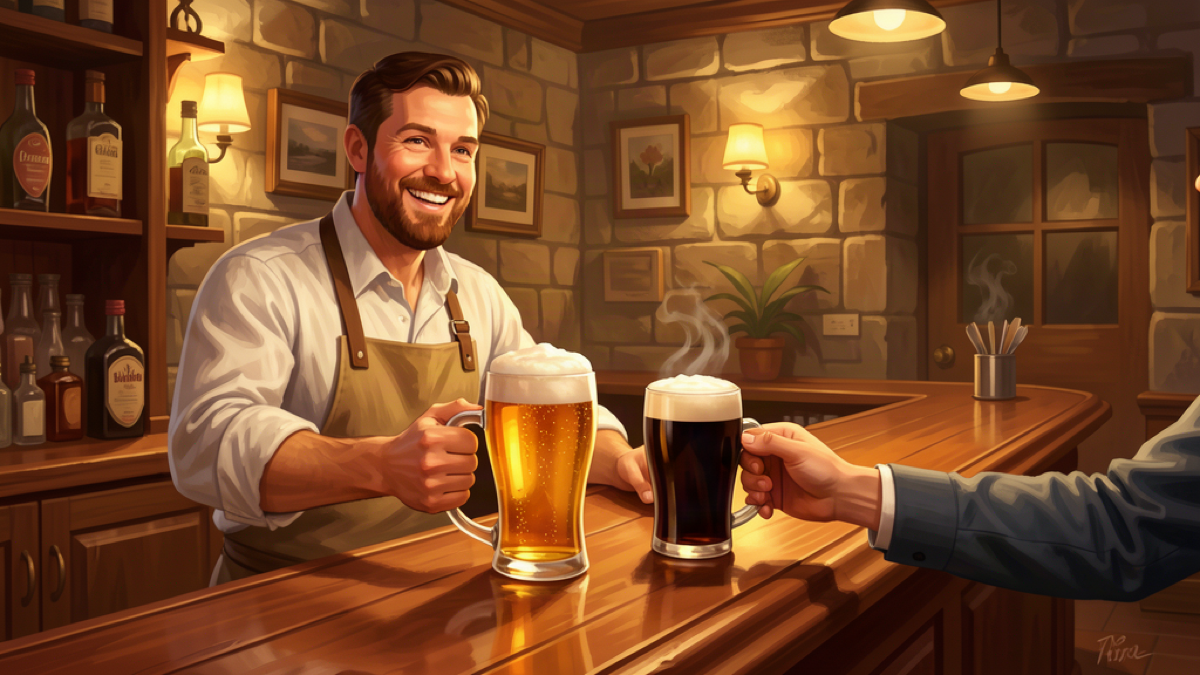
Now the order itself. In a Scottish pub, “a pint of lager” is “pint de leann”, and “a whisky” is “uisge-beatha”, the famous “water of life”. You can say “leann” for beer or lager and “brag” for malt or ale. For a coffee, “a coffee” is simply “cofaidh”, and “tè” makes it feminine in some regional constructions.
In an Irish pub the words shift slightly. “Pint” stays “pionta”, and for a beer you use “beoir”. Whisky is again “uisce beatha”, recognisable to a Scottish ear as the same phrase pronounced differently. Coffee is “caife”. The shared vocabulary across both languages shows how close the two really are, which is a theme explored in the wider comparison of the two languages.
To combine a drink with food, use your “I am wanting” line followed by the dish. “Tha mi ag iarraidh a’ phìos èisg” in Scottish means “I want the piece of fish”, while for a plate you say “truinnsear bìdh” for “plate of food”. In Irish, “ba mhaith liom” (“I would like”) followed by the noun is the most natural order, as in “ba mhaith liom bia beag” for “I would like a little food”.
For a full meal the safest strategy is to point at a board or menu item and say the item name in Gaelic. Most staff read left to right and will immediately recognise the dish even if your pronunciation is a work in progress. The vocabulary for the table itself, the plates, the utensils and the common dishes is covered in the dedicated Scottish food and drink guide and Irish food and drink guide.
Polite small talk and thanking the staff
Beyond the transaction, a few phrases make you feel (and sound) like a person rather than a tourist. To ask how someone is doing, “how are you” in Scottish Gaelic is “ciamar a tha thu?”, and in Irish it is “conas atá tú?”. Both are worth having ready.
A particularly well-loved phrase for any bar interaction is the toast. In Scottish Gaelic you raise your glass and say “slàinte” (health), and in Irish “sláinte” or the fuller “sláinte mhaith”. The words are nearly identical across the two languages, which is a small joy for anyone learning both.
To excuse yourself or to ask for the bill, “the bill, please” in Scottish Gaelic is “an àireamh, mas e do thoil e”, and in Irish “an bille, más é do thoil é”. Add “mas e ur toil e” or “más é bhur dtoil é” when speaking to staff in the plural or formal register. A simple “glè mhath” (“very good”) or “go hiontach” (“wonderful”) in reply to service keeps the conversation warm and gives you natural turns to take.
Pronunciation tips for the trickiest words
A bar is a low-stakes place to make mistakes, but a few pronunciation touches will make the words actually work. The Scottish “slàinte” is pronounced roughly “slahn-cha”, with the broad first syllable and a soft “ch” like in the name “Loch”. The Irish “sláinte” is similar, “slahn-cha”, but the accent mark lengthens the vowel slightly.
The hardest group is the “ch” sound. It appears in “cha” (as in “chan eil” or “cha robh”), and it is not an English “k” but the guttural sound from “Loch” or the German “Bach”. Practise it gently; the Scottish “ach” (meaning “but”) and Irish “ach” both use it, and getting it smooth makes you sound far more natural than any word order ever would.
The broad and slender vowels also matter for the bar vocabulary. In “caife” (coffee) the final vowel is slender, so the “c” is softer than in “cèilidh”. When a word ends in a slender vowel like “i”, the preceding consonant is pronounced closer to the front of the mouth. Rather than memorising the rule, imitate the staff: repeat the drink name back to them exactly as you heard it and they will gently correct you if needed.
Pulling it together with a practice dialogue
Reading phrases is not the same as ordering, so here is a short Scottish pub dialogue to run out loud. You: “Halò, an àireamh, mas e do thoil e.” Waitress: “Dè bhios agad?” (what will you have?) You: “Pint de leann agus pìos èisg, tapadh leibh.” Waitress: “Seo dhut.” (here you are) You: “Mòran taing!” (many thanks) You: “Slàinte mhath!”
And the Irish version, side by side, shows the same rhythm with Irish dress. You: “Dia duit. Bille, más é do thoil é.” Barman: “Céard a bheidh agat?” (what will you have?) You: “Pionta beorach agus caife, go raibh maith agat.” Barman: “Sin leat.” (there you go) You: “Sláinte mhaith!”
Run both dialogues aloud twice a day for a week, and the ordering skeleton will stick in your memory. When the moment is real, the words will come out even if they stumble, and the person across the bar will almost certainly smile. That smile is the real reward, because it is the sound of a minority language staying alive one order at a time.
Handling a surprise answer
However well you prepare, the person across the bar can answer faster than you expect, in either English or a Gaelic register you have not rehearsed. Handle it with two small habits. First, have a stock follow-up ready in Gaelic: “a-rithist, mas e do thoil e” (again, please) in Scottish, or “arís, más é do thoil é” (again, please) in Irish. This buys you a replay without ever breaking your Gaelic bubble.
Second, learn to recognise the handful of phrases that will almost certainly come back at you. A barman asking what you want will use “dè bhios agad?” in Scotland or “céard a bheidh agat?” in Ireland. Asking if you are ready, many will say “a bheil thu deiseil?” (Scottish) or “an bhfuil tú réidh?” (Irish). None of these needs a full grammatical analysis to deploy; treat each as a single memorised chunk, the way any traveller treats “how much” and “where is”.
If you do not catch a word, it takes little more than a smile and a “glè mhath” (very good, Scottish) or “go maith” (good, Irish) to keep the exchange warm. No pub conversation in Gaelic is lost for a missed phrase; it is simply the first of many.
A short word of encouragement
Gaelic pub culture is famously friendly to learners, partly because every living speaker knows how close the language came to slipping away. A learner who attempts even one phrase is usually met with encouragement rather than mockery. That means a pub is one of the safest proving grounds on earth for a shy beginner. The vocabulary is short, the structure repeats, and the audience is rooting for you.
Make the goal small and achievable: this week, greet the barman in Gaelic and order one drink. Next week, add the meal order. The week after, add the toast and the thank you. Little by little the pub phrases stop being a memorised script and start being your own voice, and that is the moment the language stops feeling borrowed and starts feeling like yours.
Put the pub phrases into practice
None of these phrases needs a native speaker in the same room to start learning. Practise the greeting, the “do you have” question, the order and the thank you as a four-line loop, then add the toast. Practise the Scottish version one day and the Irish version the next so the two do not blur. When you next walk into a bar in Scotland or Ireland, lead with “halò” or “dia duit” and ask your first question in Gaelic. The worst that happens is a warm correction, and the best is a conversation you will probably remember for the rest of the trip.
Ready to put these words into practice? FlashLearn turns any spare minute into Gaelic practice.