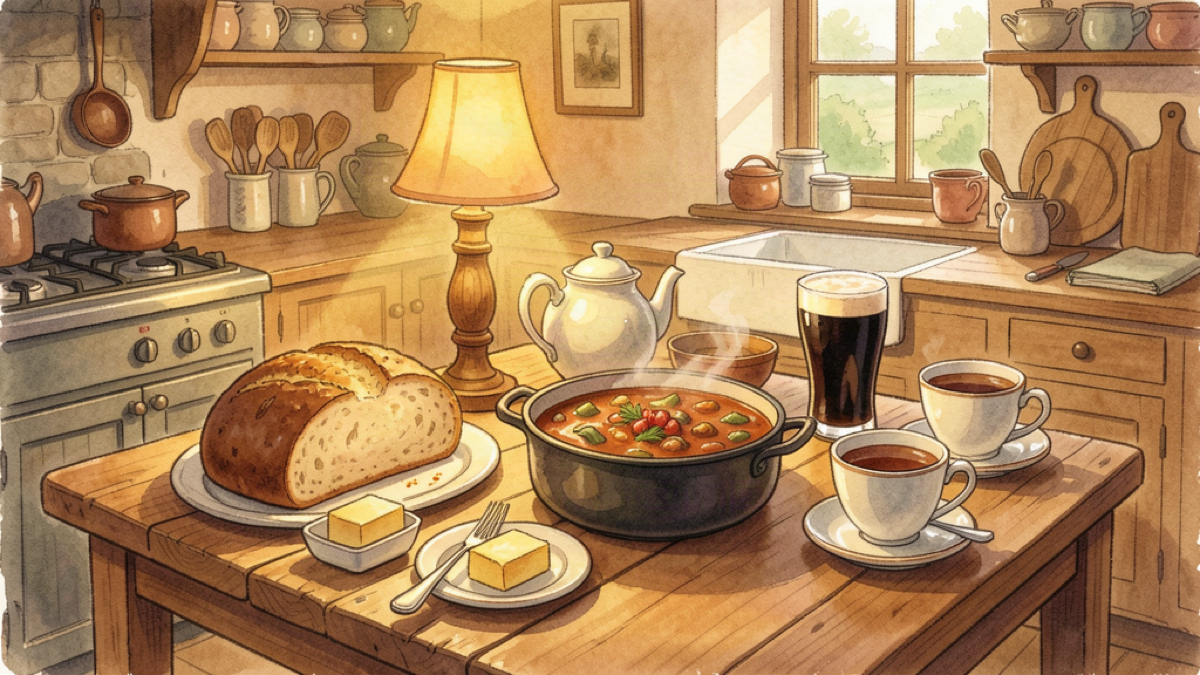
Irish Gaelic Food and Drink Vocabulary: Essential Words for the Table
Food and drink sit at the heart of Irish social life. Whether you are ordering a coffee in a Galway cafe, asking for the menu in a village restaurant, or joining friends for a cuaird (a sociable visit) where tea and cake are always on offer, knowing the vocabulary of the table opens the door to everyday Irish conversation. For the Gaelic learner, food words are also ideal building blocks: they are concrete, they come up constantly, and they fit easily into the sentence patterns you already know.
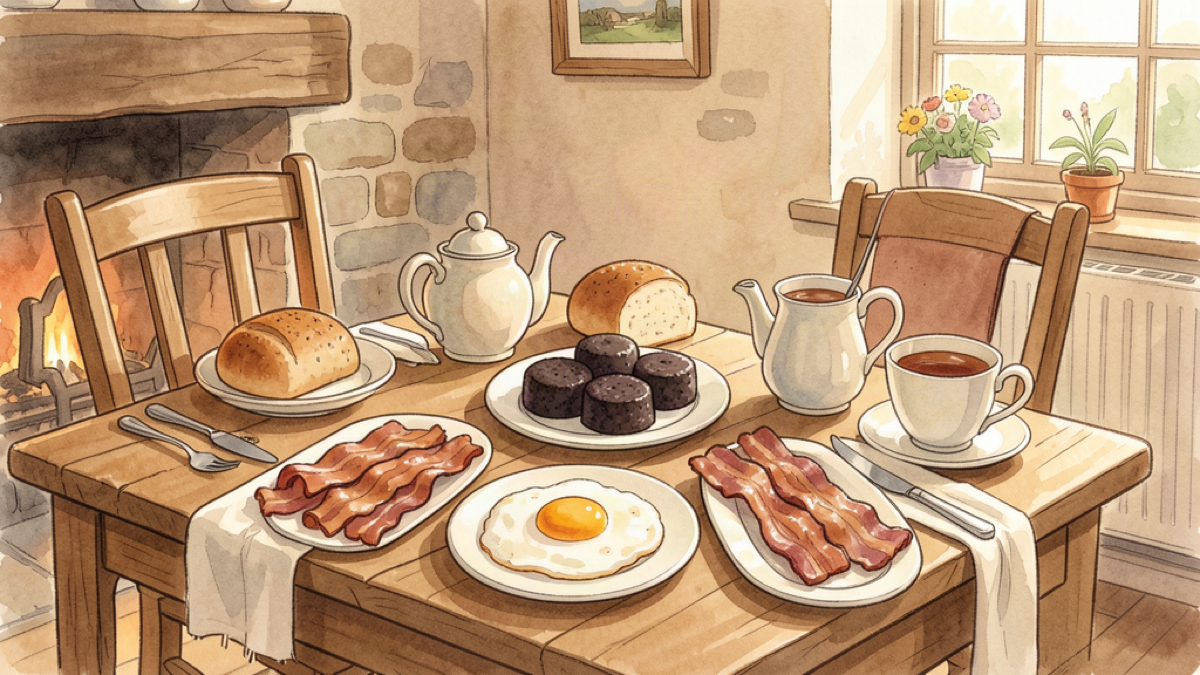
This guide gives you the essential Irish Gaelic food and drink vocabulary, how to pronounce it, and the phrases you will need to order, ask, and enjoy a meal in Irish. Start with the core words, then add the phrases, and you will be surprised how quickly they carry you through a real conversation.
The essential Irish Gaelic food words to learn first
Begin with the everyday words that appear on every table and every menu. These are the highest-value items because you will reuse them daily:
- Arán (uh-RAWN) – bread.
- Im (im) – butter.
- Cáis (kawsh) – cheese.
- Bainne (BON-yeh) – milk.
- Uisce (ISH-keh) – water.
- Tae (tay) – tea.
- Caife (KAF-eh) – coffee.
- Bia (BEE-uh) – food.
- Feoil (fyohl) – meat.
- Iasc (EES-uk) – fish.
- Torthaí (TUR-hee) – fruit.
- Glasraí (GLASS-ree) – vegetables.
- Siúcra (SHOO-kruh) – sugar.
- Salann (SAH-lun) – salt.
- Uibheacha (IV-uh-khuh) – eggs.
- Prátaí (PRAW-tee) – potatoes.
Notice some words are close to English because both languages share them or borrowed them over centuries: tae (tea), caife (coffee), salann (salt) are all recognisable. Others, like bainne (milk) and uisce (water), are distinctly Irish and will reward a little memorisation. Interestingly, uisce is the word that gave English the surname of many coastal places around Ireland, and you will meet it again in expressions about the sea.
Drink vocabulary and how to order in Irish Gaelic
Drinks are a fantastic place to start practising because ordering is short, formulaic, and social. Here is the drink vocabulary you need:
- Deoch (dyukh) – a drink.
- Uisce (ISH-keh) – water.
- Sú (soo) – juice.
- Bainne (BON-yeh) – milk.
- Tae (tay) – tea.
- Caife (KAF-eh) – coffee.
- Beoir (byohr) – beer.
- Fíon (feen) – wine.
To ask politely for a drink, the pattern is short and useful. The standard phrase for “I would like” is Ba mhaith liom (baw wah lum), literally “it would be good with me”. So you can say:
- Ba mhaith liom cupán tae (baw wah lum KU-pawn tay) – I would like a cup of tea.
- Ba mhaith liom pionta beorach (baw wah lum PEEN-tuh byoh-ruk) – I would like a pint of beer.
- Ba mhaith liom gloine fíona (baw wah lum GLIN-eh FEEN-uh) – I would like a glass of wine.
The words for cupán (cup), pionta (pint), and gloine (glass) are containers you will hear constantly. Teaming a container word with a drink word is the fastest route to sounding natural when you order. If you want the patterned question forms that let you ask questions as well as make statements, the guide to Irish Gaelic question words and the wider grammar for beginners will give you the framework to build your own sentences.
How to order at a restaurant in Irish Gaelic
Once you have the basic food and drink words, a short set of restaurant phrases lets you handle a whole meal in Irish. These build directly on the ba mhaith liom pattern you already know:
- An mbeidh … agam? (un meg … UG-um) – Can I have …? (literally “will I have …?”).
- An bhfuil biachlár agat? (un will BEE-uh-klar ug-ut) – Do you have a menu?
- Ba mhaith liom an biachlár (baw wah lum un BEE-uh-klar) – I would like the menu.
- An bhfuil rogha ar bith agat? (un will ROH-uh er bih ug-ut) – Do you have any choice?
- Níl uaim ach seo (neel WIM akk shuh) – I only want this.
- An bhféadfainn … a fháil? (un VAYD-hin … a WALL) – Could I get …?
- Cén praghas atá air? (kayn PRAY-gus a-TAW err) – What is the price of it?
- Glan an tábla, le do thoil (glahn un TAW-bluh leh duh hull) – Clear the table, please.
These sentences show you how Irish builds polite requests with the conditional and the question forms. If you want to understand the machinery behind them thoroughly, the guide to Irish Gaelic grammar for beginners and the prepositions guide will explain how the ag and ar patterns carry meaning.
A practical tip: in many Irish towns and in the Gaeltacht, service staff genuinely appreciate a little Gaeilge. Even a simple ba mhaith liom cupán tae, le do thoil goes a long way and will often earn a warm smile. It is one of the most rewarding places to try your vocabulary in the real world.
Breakfast, lunch and dinner: the three meals
Meal words anchor your whole day in a new language, and Irish uses three main ones you will need constantly:
- Bricfeasta (BRICK-fas-tuh) – breakfast.
- Lón (lohn) – lunch.
- Dinnéar (JIN-ayr) – dinner.
With these you can describe your day and invite people to share a meal. A few practical combinations:
- Bricfeasta an-mhór (BRICK-fas-tuh an-WOR) – a big breakfast.
- Tá ocras orm (TAW UK-rus UR-um) – I am hungry (literally “hunger is on me”).
- Tá tart orm (TAW tart UR-um) – I am thirsty (literally “thirst is on me”).
The pattern tá X orm (X is on me) is a wonderfully idiomatic Irish construction for feelings and needs. Ocras is hunger and tart is thirst, both expressed as something that sits on you. This is the same possessive pattern that appears throughout Irish, and once you see it, a whole set of everyday phrases becomes transparent. If you want to explore how Irish builds these ideas, the pages on the verbal noun and grammar for beginners cover the mechanisms underneath.
Politeness phrases you need at the table
No table conversation in Ireland is complete without a few polite phrases. These are short, high-frequency, and they make a genuinely good impression:
- Go raibh maith agat (guh rev MAH ug-ut) – Thank you (to one person).
- Go raibh maith agaibh (guh rev MAH ug-iv) – Thank you (to more than one person).
- Le do thoil (leh duh hull) – Please (to one person).
- Le bhur dtoil (leh wur dill) – Please (to more than one person).
- Sláinte! (SLAWN-cheh) – Cheers! / Good health!
- Tá sé blasta (TAW shay BLASS-tuh) – It is tasty / delicious.
- An-mhaith (an-WAH) – very good.
Sláinte is the toast you will hear in every pub and at every celebration, and it is one of the first words most visitors learn. Saying tá sé blasta after a good meal is a lovely, natural way to compliment your host or a cook. For a fuller set of polite expressions and their correct usage, the guide to Irish Gaelic polite phrases is a handy companion to this vocabulary.
One important note on pronunciation: the th in Irish is not like the English th. In le do thoil, the th is a gentle, breathy h sound, close to saying “hull” with a soft start. Similarly, the ch in words like sláinte (actually spelled with the lenited n carrying the sound) is a light guttural, much softer than it looks. If you want to polish these sounds properly, the Irish Gaelic pronunciation guide walks through each one with practical tips.
Traditional Irish food words worth knowing
To really connect with the culture, a handful of traditional food terms are worth adding. These come up in conversations about home, heritage, and holidays:
- Cóilín / sodar – the words around traditional baking and gatherings (regional).
- Boxty is an English loan, but you will hear arán bocht in some dialects referring to a poor or plain bread.
- Mairteoil (MAR-tyohl) – beef.
- Muiniceoil (MWIN-ik-yohl) – pork.
- Uachtar reoite (OOKH-tur RYOH-teh) – ice cream.
- Císte (KEESH-teh) – cake.
The word císte (cake) is particularly useful around cáca season and family celebrations. If you enjoy food vocabulary and want more everyday words, the Irish Gaelic weather vocabulary and the collection of everyday Gaelic phrases for beginners fill out the rest of your daily vocabulary bank.
How to remember food vocabulary with spaced repetition
Food words are plentiful, and that makes them perfect fodder for spaced repetition, the single most effective method for locking vocabulary into long-term memory. Instead of reviewing a list over and over in one sitting, space your reviews across days and weeks so each word is revisited just before you are about to forget it. Your brain treats these timely reviews as important and stores them for the long term.
A simple, practical way to apply this to food vocabulary is to organise your flashcards around real meals. Build separate decks for breakfast words, lunch words, and dinner words, then review each deck at the time of day it matches. This connects each word to a real context, which makes it far more memorable than an abstract list. For a full guide to building and using your own Gaelic decks, the page on spaced repetition for Gaelic gives you a step-by-step method, and the science piece on why spaced repetition is so effective for language learning explains the reasoning behind it.
Bring Irish food vocabulary to the table
Irish Gaelic food and drink vocabulary is practical, social, and immediately usable. Start with the core words for arán, bainne, tae, and bia, add the ordering phrases with ba mhaith liom, and round things out with the politeness and toast words like go raibh maith agat and sláinte. Before long you will be able to follow a menu, order a drink, and share a cheerful toast entirely in Irish.
The most effective way to make these words stick is to use them in real contexts and revisit them at the right intervals. Pair your vocabulary practice with the spaced repetition deck guide, and try ordering at least one item in Irish every time you buy food or drink this week. Every beoir or cupán tae you ask for is one more step towards fluency.