Irish Gaelic Body Parts: Essential Vocabulary Guide
Whether you are learning your first words or brushing up on Irish Gaelic before a trip, the parts of the body are some of the most practical vocabulary you can master. Doctors’ appointments, games with children, workout routines, and everyday aches and pains all need these words. Best of all, body parts come with several built-in memory tricks, because many words contain the story of the language itself.
Irish Gaelic body vocabulary is also a brilliant lesson in grammar. Words change their beginning with the possessive, some have irregular plurals, and a handful are connected to common expressions you will hear all over Ireland. Learn the body parts and you pull several grammar threads at once.
The head and face
The head holds the most useful body words for a beginner, partly because so many appear in idioms and everyday greetings.
| English | Irish Gaelic | Pronunciation |
|---|---|---|
| head | ceann | kyown |
| face | aghaidh | EYE-ee |
| eye | súil | sool |
| ear | cluas | kloo-uss |
| nose | srón | srohn |
| mouth | béal | bayl |
| tooth | fiacail | FEE-uh-kill |
| tongue | teanga | CHANG-uh |
| hair | gruaig | GROO-ig |
| chin | smig | smig |
A famous phrase uses ceann and súil together: ceann ar cheann means “one by one” or “head to head”. And the greeting a chroí (“my heart”, a term of endearment) shares the grammar of direct address. You will hear the body in everyday speech far more than you expect.
The upper body: from shoulders to hands
Moving down the body, the words stay short and learnable, and several rhyme with common English words.
| English | Irish Gaelic | Pronunciation |
|---|---|---|
| neck | muineál | MWIN-awl |
| shoulder | gualainn | GWOO-lin |
| arm | lámh | lawv |
| hand | lámh | lawv |
| finger | méar | mayr |
| thumb | ordóg | OR-gohg |
| chest | ucht | ukht |
| back | droim | drim |
| heart | croí | kree |
Note that Irish, like English, uses the same word lámh for both “arm” and “hand”. In context it is rarely confusing. To say my hand you say mo lámh, and the plural lámha appears in the phrase lámha suas (hands up), which you may hear used playfully with children.
The lower body: legs, feet and the words you hope to avoid
| English | Irish Gaelic | Pronunciation |
|---|---|---|
| leg | cos | kuss |
| foot | cos | kuss |
| knee | glúin | gloon |
| ankle | rúitín | ROO-cheen |
| bone | cnámh | krawv |
| blood | fuil | fwil |
| skin | craiceann | KRICK-unn |
| stomach | boilg | bwil-ig |
Again the same word cos covers “leg” and “foot”. Two words worth knowing for travel are rúitín (ankle) and boilg (stomach), because they come up quickly if anything hurts. Fuil (blood) appears in the dramatic saying tá fuil uisce ann (“there is water blood in it”), a way of saying something is watered down.
Possession and grammar: how to say “my head hurts”
This is where body vocabulary becomes genuinely useful. In Irish, possession softens the first consonant of a word (a process called lenition), just as it does in Scottish Gaelic.
- my head = mo cheann (the c softens to ch, pronounced like the ch in “loch”)
- my hand = mo lámh (l is not lenited)
- my tooth = mo fhiacail (the f disappears and adds an h, sounding like “ee-uh-kill”)
- my heart = mo chroí
The most useful sentence you can build is about pain. To say a part of you hurts, Irish uses the pattern tá … agam with a word for pain, or more simply tá pian i mo … (“there is a pain in my …”):
- My head hurts. = Tá pian i mo cheann.
- My stomach hurts. = Tá pian i mo bhoilg.
- She has a sore leg. = Tá pian ina cos.
You will notice i mo (in my) also triggers softening, which is why boilg becomes bhoilg. If grammar feels heavy, do not worry: these patterns repeat constantly, and they are covered in detail in our guide to Irish Gaelic grammar for beginners.
Body parts in everyday phrases
The Irish love to put body parts inside expressions, which makes them memorable and gives you a cultural bonus at the same time.
- as luck would have it = le cúnamh Dé (literally “with God’s help”)
- by heart = de ghlanmheabhair (literally “out of a cleaned memory”)
- I am starving = tá ocras orm (hunger is “on” me, not “in” me)
- I am thirsty = tá tart orm (thirst is “on” me)
- a kind-hearted person = duine mórchroíoch (a person with a big heart)
The pattern with orm (“on me”) is one of the most important in spoken Irish. Feelings and needs sit “on” you rather than being something you “have”. Once you learn that Irish talks about the body this way, a whole range of natural sentences opens up.
How to practise body vocabulary with spaced repetition
Body parts are ideal for flashcard review because they are concrete, visual and limited in number. You can reasonably learn every word on this page in a week of short daily sessions. The key is not to treat them as a list to memorise in one sitting, but to schedule reviews at growing intervals so each word moves from short-term memory into long-term storage. That is exactly what spaced repetition is designed to do, and it is the engine behind the best apps to learn Irish Gaelic.
Practical ideas:
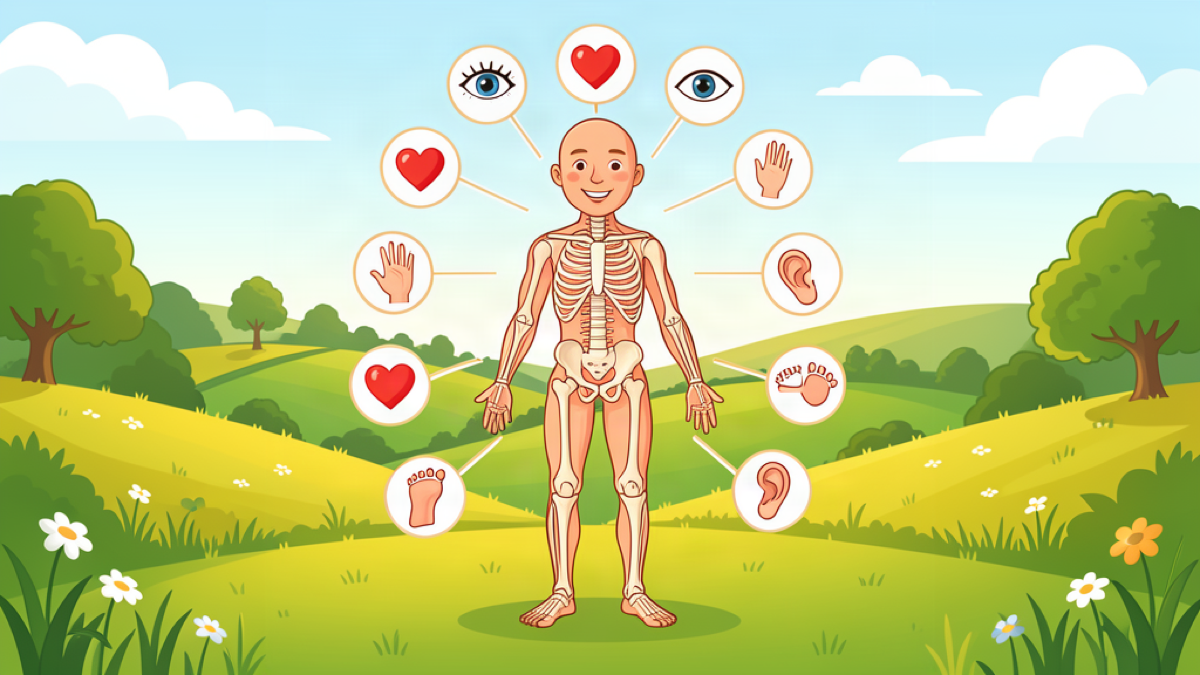
- Label your own body. Point at each part and say it aloud in Irish before you look at the page.
- Test the lenition. Practise mo cheann, mo fhiacail, mo chroí until the softened form comes out without thinking.
- Build pain sentences. It is morbid but effective: Tá pian i mo … is the sentence you will need most in an emergency.
Conclusion
The parts of the body give you a compact, high-frequency vocabulary that unlocks real conversation, useful emergencies, and a window into how Irish talks about feelings and belonging. Combine the words with a little grammar, review them at the right intervals, and you will have them for life.
Put these words into practice today. Download FlashLearn Irish Gaelic for a ready-made body parts deck with spaced repetition, or open the Gaelic web app to review across all your devices in minutes.