Sean-nós Singing: The Unaccompanied Tradition of Irish Song
Long before recording studios and amplified stages, Irish music was sung by one person, with no instrument, in kitchens, pubs and ceilidhs across the country. That tradition, known as sean-nós (pronounced “shan-noss”, meaning “old style”), is one of Ireland’s most profound cultural treasures. It is unaccompanied, highly ornamented and deeply tied to the Irish language, and for learners of Irish Gaelic it is simultaneously a beautiful window into the culture and an extremely effective way to train the ear. This guide explains what sean-nós is, how it differs from ordinary singing, why it matters for the language, and how you can start listening to and learning it today.
What makes sean-nós different
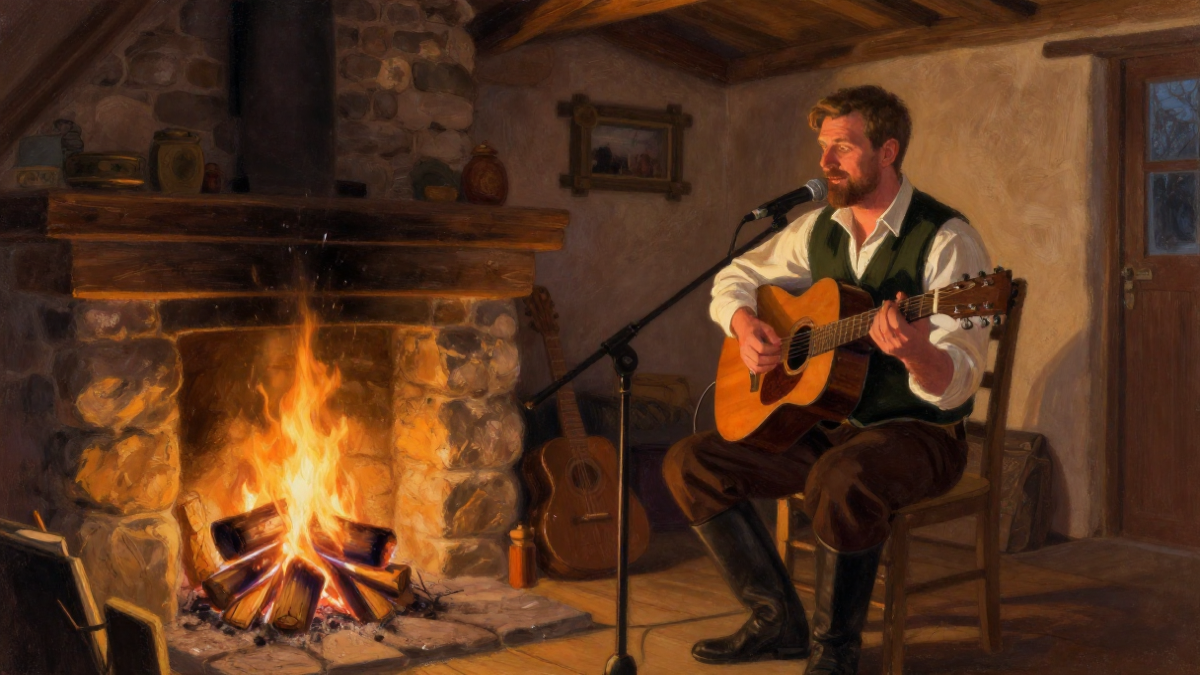
Sean-nós has one defining feature that sets it apart from almost all popular music: there is no instrumental accompaniment. The singer stands alone, and the voice must carry everything, the melody, the rhythm and the ornamentation. This is not a limitation but the point of the style. The ornaments, the little decorations woven into the melody, replace the instrumental fills you would hear in a band arrangement, and the singer’s control of timing and decoration is the measure of skill.
The style is also fundamentally word-driven. The words of a sean-nós song are not a secondary element set onto a melody; the melody is shaped by the words, with the ornaments flowing from the vowels and consonants of the Irish language. This is why the tradition is inseparable from Irish. A sean-nós singer who does not understand the lyrics may produce the notes, but the ornamentation, which lands on specific syllables and rises and falls with the accent of the words, is driven by the language itself. For a learner, this makes sean-nós the purest possible ear-training: the music is the language, sung.
The ornaments: melisma and the art of decoration
The most distinctive feature of sean-nós is its ornamentation, and the style uses specific techniques that singers spend years polishing. Melisma is the stretching of a single syllable across several notes, often in a slow, deliberate way that lets the singer explore the vowel. The Irish crónán and the little slides and cuts between notes give the melody its flowing, almost liquid quality. A skilled singer does not force ornaments; they grow out of the natural rhythm of the words, which is why the ornamentation sounds effortless even though it is finely controlled.
There is also a characteristic light, unforced vocal production. Sean-nós singers generally avoid the powerful, belted sound of musical theatre or opera. The tone is more intimate, closer to conversation, and the singer lets the melody rise and fall as the words dictate. This restraint is deliberate: it allows the Irish language to sit naturally in the mouth, and it gives the songs their haunting, contemplative quality. The specific ornaments differ slightly between the regional styles, and the three Irish dialects each have their own flavour, which is another reason the style rewards close listening.
The two great song traditions
Sean-nós repertoire falls broadly into two categories, and knowing the difference helps enormously when you begin. The first is the amhrán, the slow, highly ornamented song. These are often laments, love songs or songs of exile, and they give the singer the space to place every ornament with care. The second is the caoineadh, the traditional lament or keening song, historically sung at wakes, which is among the most emotionally intense music in the Irish canon. Many learners start with amhrán because they are slower and the words are easier to follow.
The other great branch of the tradition is the sean-nós of Gaelic Scotland, the unaccompanied puirt à beul, or mouth music, and the waulking songs once sung by women while fulling cloth. The two traditions share roots in the same Gaelic culture and the same love of ornament and word-driven melody, and exploring both is a wonderful way to understand the Gaelic music and poetry world across Scotland and Ireland. For an Irish learner, starting with the Irish amhrán and then branching into the Scottish puirt à beul gives you the full picture of what unaccompanied Gaelic song can do.
Why sean-nós is superb ear training for Irish
For anyone learning Irish, sean-nós is not a distraction from the grammar and vocabulary; it is one of the most effective tools for building the ear. Because the singer stretches vowels and ornaments consonants, the songs expose you to the full range of Irish sounds, many of which have no direct equivalent in English. The slender and broad consonants, the fada length on vowels, and the characteristic rhythm of the language all appear in an exaggerated, beautiful form. Listening to sean-nós puts these sounds into your ear at a depth that ordinary speech rarely matches.
Learners who sing along find the effect is even stronger. When you sing the words, you must produce the sounds yourself, with correct length and quality, and you build the muscle memory of the language. This is the same principle behind the advice to learn Irish through music and song: the melody gives you a scaffold for pronunciation and rhythm, and the repetition of a chorus locks phrases into long-term memory far more effectively than rote study. Singing a sean-nós song is, in effect, a pronunciation lesson with a beautiful soundtrack.
The emotional and cultural weight of the songs
Sean-nós songs are also a direct line to Irish history and identity. The laments mourn lost lovers and emigrants; the songs of exile describe the pain of leaving Ireland; the humorous songs poke gentle fun at village life; and the lullabies carry generations of mothers’ voices. Because many sean-nós songs were passed down orally, they preserve a vocabulary and a way of seeing the world that has largely disappeared from everyday Irish. For the learner, they are a trove of poetic words, idioms and structures that you will meet nowhere else.
This is part of why sean-nós matters to the wider preservation of Irish Gaelic. The tradition is carried by living singers, many of them in the Gaeltacht regions, and each generation passes the songs on by ear. When a learner takes up a sean-nós song, they are not just learning vocabulary; they are entering that chain of transmission and helping keep a profoundly old art alive. Singers are famously generous with their time and knowledge, and many are delighted to teach a learner their first song.
How to start listening and learning
You do not need a music background to begin. The best first step is simply to listen a great deal. Seek out recordings of the great singers, the masters of the tradition, and let the ornamentation and the flow of the words become familiar before you try to reproduce them. Radio programmes dedicated to traditional music, festival recordings and the archives of national broadcasters are all rich sources, and the search for live music in the Gaeltacht is one of the most rewarding reasons to visit. On the same bands you will find the singers of the tradition, and many sessions welcome learners to quietly observe and absorb.
When you are ready to learn a song, choose a slow amhrán with a clear, singable melody and a story you can understand. Find the words, read them aloud until you are comfortable with the pronunciation, and then sing along with a recording many times before attempting the song alone. This mirrors how the tradition is actually passed on, by ear and by repetition, and it is far more effective than trying to read music. As your pronunciation improves, revisit the guide to sounding natural in Irish to sharpen the sounds you have been practising in song.
Building sean-nós into a learning routine
The beauty of sean-nós for the busy learner is that it fits into any daily routine. A commute, a walk or a few minutes in the morning is enough with a song or an archive recording, so you can build listening into your day without carving out extra study time. Pair this listening with a spaced repetition review of the song lyrics and any new vocabulary they contain, and you convert what feels like passive pleasure into active language acquisition. The more you move from simply listening to actively singing, the more the language enters your working memory.
For structured practice, the same flashcard approach that underpins Flashlearn Irish Gaelic works beautifully with songs: split each song into short lines or couplets, review them with their translations, and gradually assemble the whole song. Over a month or two, a handful of songs gives you a solid core of words, a much better ear, and the satisfying ability to sing something beautiful in Irish to a friend.
Conclusion
Sean-nós singing is far more than an old-fashioned curiosity; it is the living heart of Irish music and one of the best tools an Irish learner can possess. Its unaccompanied, ornamented style is intimately bound to the Irish language, its slow amhrán make an accessible entry point, and its repertoire carries the memory and emotion of centuries. Listening builds your ear, singing builds your pronunciation, and both connect you to the living tradition that keeps the language strong. Find a singer you love, put their music on repeat, and let the old style do its slow, powerful work on your Irish.