Scottish Gaelic Family Words: How to Talk About Relatives
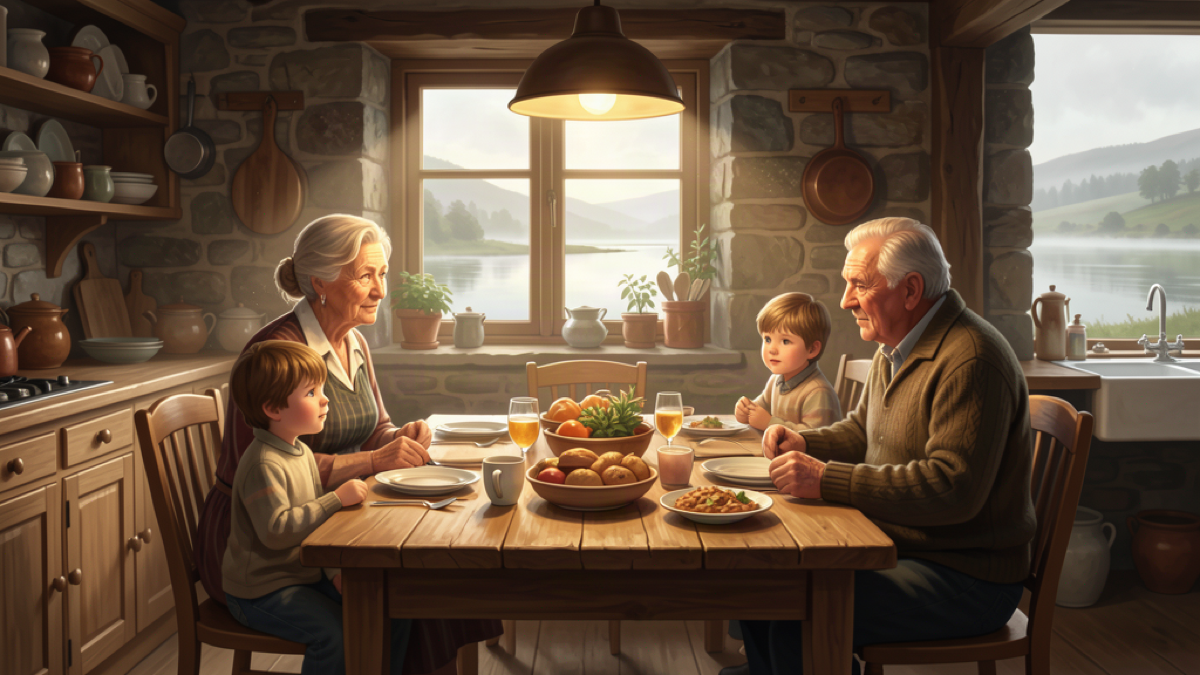
The family is where language lives. Children learn their first Gaelic words around the kitchen table, grandparents pass down stories in the ceilidh house, and two or three generations often sit together at the same meal. If you want to move beyond tourist phrases and into real conversation, learning the Scottish Gaelic family words is one of the most useful and rewarding steps you can take.
Family vocabulary gives you the words you will actually use every single day. It also teaches you grammar in context. Possession, lenition and the genitive all show up in ordinary sentences like “my mother” or “your grandmother”. Learn these words and you unlock both a rich vocabulary and a practical way into the structure of the language.
The Immediate Family: mother, father, son and daughter
Let us start with the words you will use most often. Scottish Gaelic has specific words for immediate family members, and a few of them will feel completely natural to an English speaker.
| English | Scottish Gaelic | Pronunciation |
|---|---|---|
| mother | màthair | MAH-her |
| father | athair | AH-her |
| parents | pàrantan | PAR-un-tan |
| son | mac | mahk |
| daughter | nighean | NYEE-uhn |
| child | pàiste | PAHSH-chuh |
| children | clann | kloun |
The word clann is worth a special mention, because you have probably heard it before. In many Scottish and Irish surnames, clan means the children or descendants of a shared ancestor. In everyday Gaelic it simply means children: tha trì clann aice means “she has three children”.
Siblings and partners
| English | Scottish Gaelic | Pronunciation |
|---|---|---|
| brother | bràthair | BRAH-her |
| sister | piuthar | PYOO-er |
| husband | fear | fehr |
| wife | bean | ben |
| baby | leanabh | LEN-uh-uhv |
| a couple | càraid | KAH-rid |
Notice how similar the words for “brother” and “mother” sound: bràthair and màthair. And piuthar for sister has no English cousin, so it is often the first word learners forget. The trick is to practise it in a full sentence, not alone.
Possession and lenition: how to say “my mother”
Here is where family words become a grammar lesson. In Scottish Gaelic, possession changes the beginning of the word. Add the possessive mo (my), do (your) or a (his/her) and in many cases the first consonant is “lenited”, meaning it is softened.
- my mother = mo mhàthair (the m softens to mh, pronounced more like a v)
- my father = m’ athair (with a dropping the o before a vowel)
- your brother = do bhràthair (the b softens to bh)
- her sister = a piuthar (no change, because p is followed by a built-in vowel cluster)
- my son = mo mhac
- my daughter = mo nighean (no lenition on n)
The pronunciation matters as much as the spelling. Mh inside a word sounds like the v in “van”: mo mhàthair is roughly “meh VA-her”. Bh sounds like the same v: do bhràthair is “deh VRAH-her”. If you want to sound natural rather than robotic, you cannot skip this. For a fuller guide to how Gaelic consonants change in context, see our guide to Scottish Gaelic lenition.
The extended family: grandparents, uncles, aunts and cousins
Once you have the immediate family, the extended family opens up the conversation. Scottish Gaelic has two common ways of saying grandmother and grandfather, one traditional and one more colloquial.
| English | Scottish Gaelic (common) | Alternative |
|---|---|---|
| grandmother | seanmhair | màthair-mhòr (big mother) |
| grandfather | seanair | athair-mòr (big father) |
| uncle | uncail | bràthair-athar (father’s brother) |
| aunt | antaidh | piuthar-athar (father’s sister) |
| cousin | co-ogha | – |
| nephew | mac-bràthair (son of brother) | – |
| niece | nighean-bràthair (daughter of brother) | – |
The longer forms are lovely and descriptive. Màthair-mhòr literally means “big mother”, and you will hear it across the Highlands and islands. Describing a relation by who they are connected to, as in mac-bràthair for nephew, is a very Gaelic way of building words.
Talking about your family in a full sentence
Family words are only useful when they come out in real sentences. Here are five patterns you can start using immediately. Notice how aig (“at”) expresses possession, which is one of the most distinctive features of the language.
- I have two brothers. = Tha dà bhràthair agam.
- My mother is from Lewis. = Tha mo mhàthair à Leòdhas.
- My father’s name is John. = ‘S e Iain a tha air m’ athair.
- She has no children. = Chan eil clann aice.
- This is my grandmother. = Seo mo sheanmhair.
The phrase Tha … agam (literally “there is … at me”) is the standard way to say “I have”. It is worth learning early because it appears constantly. The verb tha is the backbone of most Gaelic sentences, and you can read more about how it works in our guide to Scottish Gaelic verbs for beginners.
Addressing family members directly
When you talk to a family member rather than about them, Gaelic can use the vocative form, which softens the word for direct address. The most famous example is a mhàthair (“mother” when calling to her) and the affectionate a ghràidh (“my dear”).
- Grandma! = A sheanmhair!
- Mum! = A mhàthair!
- My darling. = A ghràidh.
These forms appear all the time in Gaelic songs and poetry, so recognising them early helps you understand lyrics too. When you hear a singer call out a ghràidh, they are not being grammatically strange; they are simply using the vocative the way it has been used for centuries.
How to learn family vocabulary that sticks
Family words are the perfect candidates for memory work because they are small, high-frequency and tied to real people. The strongest method is to attach each word to an actual or imagined relative. Picture your own family and say mo mhàthair, m’ athair, mo phiuthar out loud. Turning abstract vocabulary into something personal is the fastest way to make it stay, and it is the same logic behind spaced repetition, which stretches your reviews just before you are about to forget. You can build a custom deck of family words using our spaced repetition guide for Gaelic.
A few practical tips:
- Say the sentences, not just the words. Mo mhàthair on its own is fine, but Tha mo mhàthair à Dùn Èideann (“my mother is from Edinburgh”) is real communication.
- Practise the lenition from day one. Do not save it “for later”; it is baked into the possessive.
- Test yourself both ways. English to Gaelic for speaking, Gaelic to English for listening.
Conclusion
The family vocabulary of Scottish Gaelic is small enough to master quickly and rich enough to teach you the hidden grammar of the language. In a single sentence about your mother, you encounter possession, lenition and the verb to be. Practise the words, use them about real people, and review them at the right intervals, and you will soon be talking about your family with confidence.
Ready to put these words into practice? Download FlashLearn Scottish Gaelic to study a family vocabulary deck with spaced repetition, or open the Gaelic web app to review on any device in minutes.