How to Teach Irish Gaelic to Children: A Practical Family Guide
Passing a minority language to the next generation is the single most effective thing any family can do for its survival. Classroom lessons teach adults who mostly stop, but children who grow up hearing and using a language at home become native speakers for life. For Irish Gaelic, an estimated one in three speakers learns the language in the home or the community rather than in school, which is why family transmission matters so much.
If you are a parent who speaks some Irish, or a grandparent with an Irish-speaking heritage, you may wonder whether it is realistic to raise a child with the language, especially if you are not fluent yourself. The honest answer is that you do not need to be fluent to start. You need a plan, consistency, and realistic expectations. This guide explains the methods that actually work for teaching Irish to children, whether the child is a baby, a preschooler, or a school age learner.
Start with sound and songs, not grammar
Children acquire language through sounds and meaningful repetition long before they understand any rules. This is the opposite of how many adults try to learn, and it is exactly why children can become fluent in Irish faster than their parents. Your first job is not to teach the difference between an and na, it is to fill the child’s ears with the language.
Irish has sounds that English lacks, like the slender and broad consonants and the tricky vowels with fadas, the accent marks that change a word entirely. Hearing these sounds from real speakers, whether a parent, an aunt, or a recording, trains a child’s ear during the critical window when their brain is still mapping the speech sounds of every language around them.
Music is your most powerful tool. Irish traditional songs and lullabies carry vocabulary, natural rhythm, and the emotional warmth that makes a child love a language. Sing the same songs every day and the words become automatic. Nursery rhymes work the same way for toddlers, giving you short, repeated chunks that a small child can eventually join in singing.
Everyday routines build the habit
The best time to teach a child a language is during the repetitive routines of daily life, because these are the moments where meaning is obvious. Bath time, bedtime, mealtime, getting dressed, and going out are all built from the same short sentences used over and over. If you learn the Irish for those sentences and use them every single time, the child learns the connection through context, not through translation.
Start with a handful of essential phrases you say many times a day. Greetings, praise, requests, and simple questions are the highest value items because they repeat constantly. Say “maith thú” for well done, “tar anseo” for come here, and “a bhéile” to call them to their meal, and you will say each dozens of times a week without any extra effort.
Do not worry about making everything Irish at once. A few routines in Irish surrounded by an English speaking world is realistic and effective. What matters is that the Irish is there every day, embedded in moments the child understands, rather than isolated in a weekly lesson that has no connection to real life.
Use television and books wisely
Screen time can be a genuine ally if you choose the right content. Today there are Irish language cartoons and shows made for children, and the local broadcaster makes a real effort to offer children programming in Irish. A child who watches an Irish language cartoon daily is soaking up sentence structure and vocabulary while being entertained, no study required.
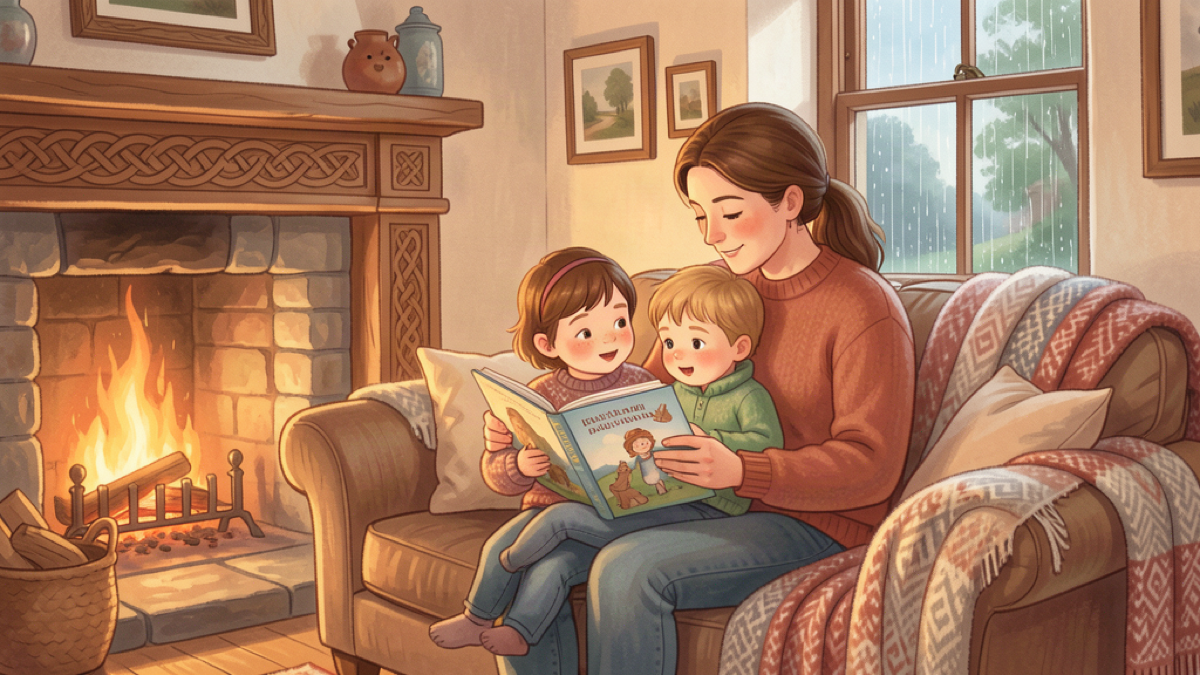
Books are just as important. Look for simple Irish picture books with one object per page and the word written clearly, then move to short stories with repetitive text that a child can predict and eventually read themselves. Read the same favourites again and again, because children love repetition and it is precisely the repetition that makes the language stick.
When you read, point at the pictures and say the words, then encourage the child to name what they see. This turns a passive activity into an active one and builds the vocabulary they need before they can speak in full sentences.
Using language apps and games as support
Modern families cannot ignore the pull of screens, so it is smarter to make the screens work for the language rather than against it. There are Irish language apps and digital games aimed at young learners, and even a mainstream children’s app can be switched into Irish if the child sets their profile that way. When a child routinely plays a game or watches a show in Irish, they stop thinking of the language as a school subject and start treating it as an ordinary part of their day.
The key is balance and consistency rather than quantity. A short daily session in Irish, whether it is an app, a game, or a song, beats a long session once a fortnight. Make Irish media the default for a particular slot, like the morning cartoon or the screen time after dinner, so it becomes an expected part of the routine rather than a treat that can be traded away.
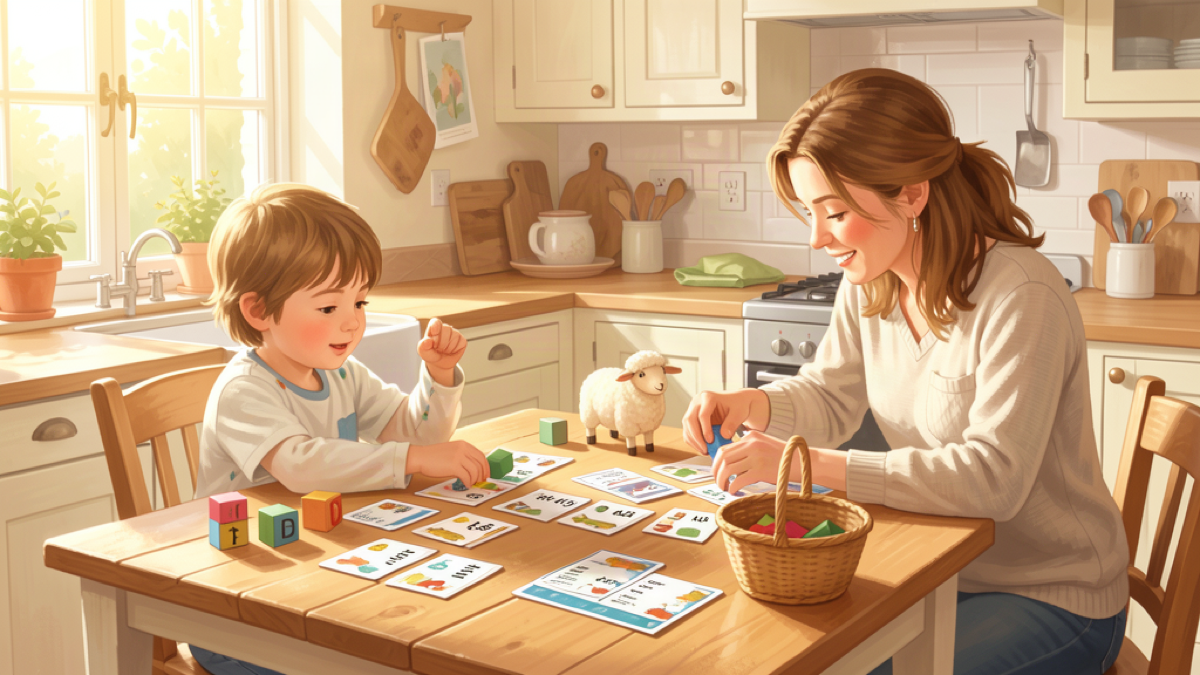
Traditional board games can also be adapted. A game of memory cards where every card is an Irish word, a bingo game built from Irish vocabulary, or a simple quiz about family photos all turn the language into play. The child is far more likely to remember words they learned while laughing than words they were told to memorise.
Make it a language you do together, not one you force
Children are remarkably good at resisting anything that feels like a chore, and a language that is only ever presented as work will meet exactly that resistance. The families that succeed treat Irish as a source of play, connection, and identity rather than as a subject. Games, songs, outings, and jokes in Irish all reinforce the idea that the language is fun and that it belongs to the family.
One of the strongest identities a child can carry is the sense that they speak something special that most people do not. Grandparents who speak Irish can be a huge motivator, because the language becomes a bridge to beloved relatives and a family heritage. A child who associates Irish with love, laughter, and their grandparents will want to keep it, not resist it.
Be realistic about the language you can offer
If you are honest with yourself about your own Irish, you will make better choices. A child needs exposure to fluent, natural Irish to develop a good accent and full grammar, so if your own fluency is limited, build in outside input early. Irish language playdates, summer camps, holidays to the Gaeltacht, and tutors all give the child native level examples to complement what you can offer at home.
You also need to accept that the child may answer you in English even when you speak Irish. This is normal and it is not failure. Keep speaking Irish yourself, keep the input steady, and resist the urge to demand that they reply in Irish. Passive comprehension comes first, and it is a solid foundation even before they choose to speak back.
The Gaeltacht, the Irish speaking regions of Ireland, are the ultimate resource. Even a week there immerses the child in a community where Irish is genuinely used for everyday life, and the experience of hearing the language everywhere can shift their motivation from abstract to real.
A small daily plan for each age
For a baby or a toddler, focus on songs, lullabies, and the few phrases you repeat in their carer routine. The goal is exposure and association, not vocabulary counts.
For a preschooler, add nursery rhymes, picture books, a daily cartoon, and questions about what they can see. Use praise in Irish every time they try, even imperfectly.
For a school age child, weave Irish into a consistent routine, keep a bookshelf of Irish books, use a weekly cartoon, and introduce family games where the words are Irish. Encourage conversations about their day, however short.
What to do when your child resists or answers in English
Every family trying to raise a child bilingually meets a stage of resistance. The child may refuse to speak Irish, insist on English, or even bluntly tell you that Irish is not their language. This is one of the most common sticking points, and it is important to understand that it is a phase, not a verdict on your efforts.
The first rule is never to punish a child for using English. Bilingual children typically develop a dominant language, and in most Irish families that is English, because the world around them uses it everywhere. If you scold a child for answering in English, you risk associating the Irish language with negativity, which is the opposite of what you want. Instead, praise every attempt at Irish enthusiastically and just keep using it yourself.
The second rule is to make English the less interesting option, without making it forbidden. When the child wants something, the parent can respond naturally and affirm in Irish. When you read together, the Irish books get the excited reading voice. When you watch TV together, the Irish cartoon is the fun one. You are gently steering, not forcing.
The third rule is to find the child’s strongest motivation. For young children that is often a beloved character or relative, a grandparent, a favourite song, or an imagined identity as a secret speaker of a magic language. For older children it may be an interest in music, sport, or family history. Whatever hooks the child gets the best chance.
If you are the only Irish speaker in the child’s life, partner with other families, grandparents, or a tutor, so the child sees that Irish is not just one parent’s quirk but a real language other people speak. A summer in the Gaeltacht or a regular visit to an Irish speaking gathering can do more for motivation in a week than months of gentle nudging at home.
Why the effort is worth it
Every child who grows up with Irish is a vote for the future of the language, and one child who becomes a fluent adult speaker is worth more than any number of adult classroom learners. Beyond the preservation argument, bilingual children gain real cognitive benefits: better attention control, stronger problem solving, and an easier time learning additional languages later. These advantages are shared by every bilingual child, whether the second language is Irish, Welsh, Scottish Gaelic, or any other tongue.
You do not need to be a perfect speaker to give a child the gift of Irish. You need to be a consistent one. Start with the songs, build the routines, fill their ears with the language every day, and let the child speak when they are ready. That steady, loving, daily input is what keeps Irish alive in a family, and what turns a heritage language from something your parents spoke into something your children speak too.
If you are starting your own Irish Gaelic learning journey to support your family, look for resources that combine the everyday phrases you will actually use with the pronunciation you need to get them right. A little daily effort, a few songs, a stack of picture books, and a commitment to speaking Irish every day will carry you and your child far further than any crash course.