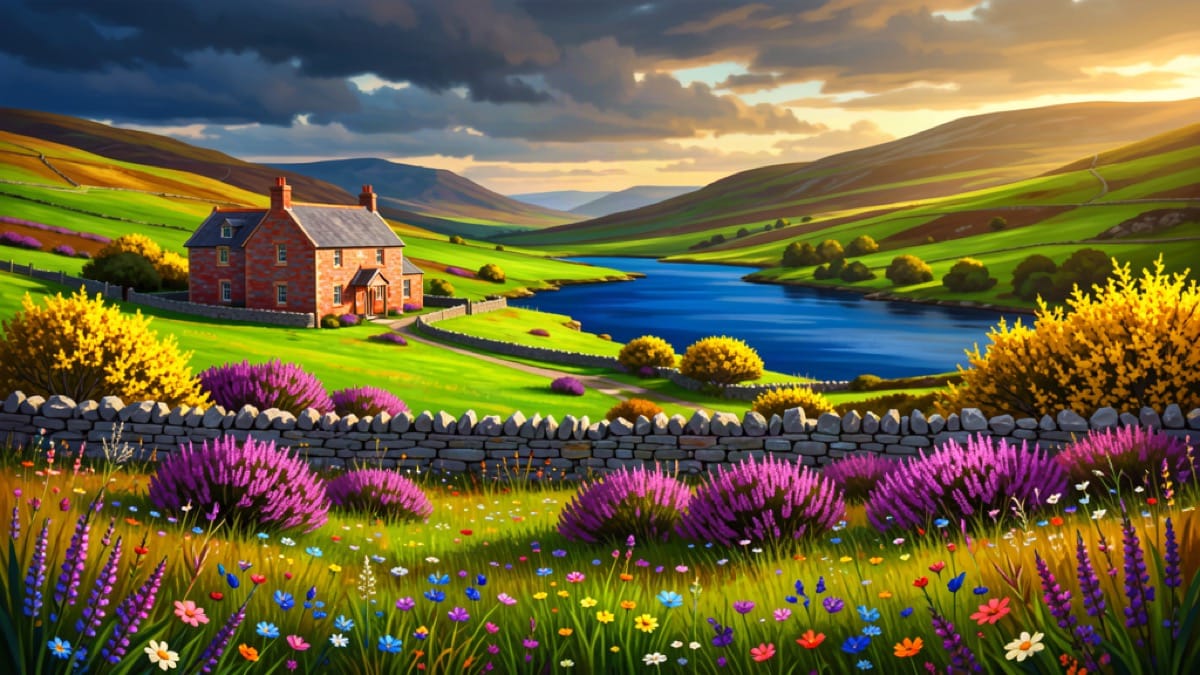
Scottish Gaelic Colours and Adjectives: Describing Your World in Gaelic
When a learner opens a Gaelic phrasebook, the first words they meet are usually greetings, numbers and travel essentials. Colours and adjectives wait a little further in. That is a mistake. Descriptive words are the easiest way to move from memorising isolated items to actually speaking in sentences, because they let a learner react to the world around them in real time: the red car, the cold morning, the deep blue loch.
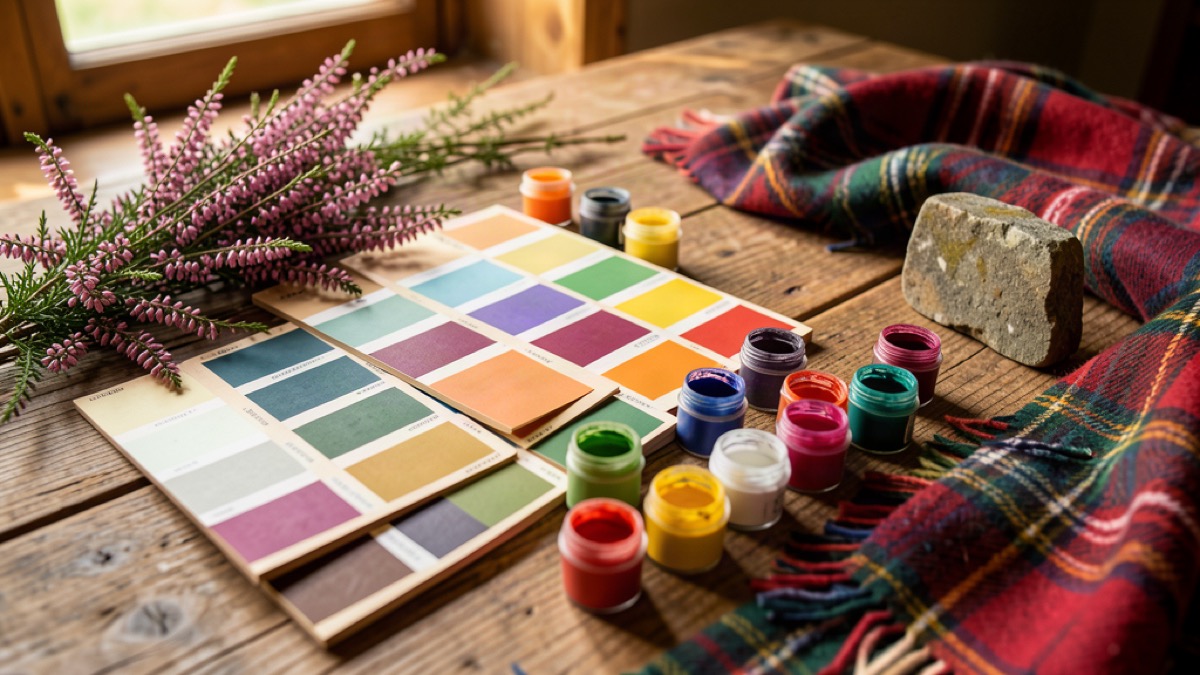
Mastering Scottish Gaelic colours and adjectives is also the gateway to one of the language’s most distinctive features: lenition, the softening of the first sound of a word when a grammatical relationship is formed. The pattern depends heavily on the sounds beginners struggle with, so building an accurate ear early pays off. A learner who understands how adjectives behave after a noun has unlocked a pattern that appears in almost every Gaelic sentence they will ever read.
The core Scottish Gaelic colours (dath)
The twelve most common colours in Scottish Gaelic are short, direct words and almost all of them have direct translations in English:
- Dearg, red
- Gorm, blue
- Uaine, green
- Buidhe, yellow
- Geal, white
- Dubh, black
- Donn, brown
- Pinc, pink
- Orains, orange
- Purpaidh, purple
- Glas, grey
- Airgead, silver
Most colours come from Old Irish and many survive in place names across the Highlands. Barr Dearg in Sutherland carries the word for red in its name, while Loch Liath Br eil is not far from a grey loch. Learning the colour words is therefore also a window into Scottish geography, because the landscape has been naming itself in these exact terms for centuries.
Light and dark: shading colours the Gaelic way
English builds shades with separate words such as light blue or dark green. Scottish Gaelic does something more compact: it uses the particles bàn, meaning light or fair, and dom, meaning dark or deep, placed before the colour. Speaking Gaelic, a learner says bàn gorm for a pale blue sky and dom uaine for a deep green pine forest. This is far more economical than English, and it is one of the first patterns a beginner notices that has no direct verbatim equivalent in their native tongue.
This matters for describing weather and the landscape, which any visitor to Scotland will do constantly. A winter morning is a bàn liath day of pale grey light, while a storm cloud brewing over a peak is a dom donn mass of dark brown and grey. Once a learner has both the colour and the light or dark modifier, describing most scenes is simply a matter of placing the modifier in front of the colour. For the exact forms and a full sound guide, the LearnGaelic section on colours is a reliable reference.
Adjectives come after the noun
The most important rule about Scottish Gaelic adjectives is that they follow the noun they describe, the opposite of English word order. A learner says taigh mòr, a big house, and not mòr taigh. The noun comes first and the adjective trails behind it, exactly as in Irish, Welsh and the other Celtic tongues.
This reverse order feels strange at first and it is the single most common error among new students, who instinctively want to translate their English word order into Gaelic. The fix is deliberate repetition: build short noun plus adjective pairs and drill them until the structure stops passing through English. A useful trick is to think of the adjective as a descriptive tag attached to the noun, rather than a separate word sitting in front of it.
Mutation after the noun: lenition
Here is where Scottish Gaelic colours and adjectives connect to the deepest rule in the language. When a feminine noun is followed by an adjective, the adjective is usually lenited: its first consonant is softened. The spoken signal is an extra h inserted after the first letter, as in the shift from b to bh, pronounced like a v. So a white house, taigh geal, changes to a white door, dor shea, because the feminine noun dom lenites the following geal to shea.
Beginners do not need to learn every mutation chart on day one, but they do need to know that the phenomenon exists and that it is why Gaelic spelling looks heavier than the spoken language. The written h is a historical marker of a softer sound, not an extra syllable. Learners who understand this early avoid the frustration of seeing words in writing that sound different from how they are spelled.
Grading colours: from pale to deep
Colours also grade through the same light and dark particles already described, and through comparative forms used to express degrees of a quality. To say that one thing is redder than another, Gaelic pushes the adjective into a comparative form, often by adding a syllable such as is or e. These comparatives are irregular in several common adjectives, so a small vocabulary of ready-made comparisons pays off.
Practically, learners can describe most real situations with the basic form plus bàn and dom, and only move to comparatives once they feel comfortable building simple noun phrases. This staged approach keeps motivation high because it lets a learner say useful things long before the grammar is fully mastered. The language rewards incremental progress more than cramming.
Putting it together: describing objects and scenes
The real test of any descriptive vocabulary is using it in a sentence. A learner who can name a few colours and a few basic adjectives can already produce combinations like the old grey stone house, the little black cat or the deep blue sea. Constructing these is a matter of applying two rules: keep the noun first, then attach the adjective, and remember the feminine lenition triggers.
A good speaking exercise is a daily scene walk. While walking outside, a learner names every object they see in Gaelic and immediately gives it a colour or a quality: the white cloud, the green field, the loud bird. This forces the words into active memory instead of leaving them as passive recognition, and it trains the reverse word order in a natural setting. Ten minutes of this a day builds more fluency than an hour of silent reading.
How to practise Scottish Gaelic colours with flashcards and spaced repetition
Because colours and adjectives are a closed, learnable set, they are perfect for flashcards and spaced-revision. An app built around spaced repetition lets a learner review the colours at expanding intervals so that each word survives the transition from short-term to long-term memory. The science of spaced repetition is well established: people recall items far more durably when reviews are timed to the edge of forgetting rather than crammed together, which is why spaced repetition is so effective for language learning.
A smart way to build these cards is to make each card a phrase rather than a single word, so the learner practises both the vocabulary and the adjective-after-noun order at the same time. Writing red car on one side and càr dearag on the other embeds the grammar into the flashcard, which is far more useful than a bare word pair. Repeating this with every colour builds a solid descriptive base quickly.
Common mistakes and how to avoid them
Nearly every beginner stumbles in the same places. The first is putting the adjective before the noun out of English habit. The second is forgetting that descriptive modifiers such as bàn and dom sit in front of the colour, not after it. The third is ignoring lenition after feminine nouns and therefore writing forms that look almost right but are grammatically suspicious to a native ear.
None of these errors is fatal, and all of them fade with consistent input. Listening to Gaelic music and poetry trains the ear to hear where the softening occurs, and reading simple sentences shows the adjective patterns in context. Building daily practice around everyday Gaelic phrases reinforces the same structures in real use. Every mistake a learner makes and corrects is a step toward the point where the structure becomes automatic, so the advice is simply to keep producing the language rather than waiting until it feels perfect. For the clearest guidance on the full sound system, the Scottish Gaelic pronunciation guide is an excellent companion.
Conclusion
Scottish Gaelic colours and adjectives may be the most practical gateway into the whole language. They are a small, learnable set of words, they instantly make speaking possible, and they introduce the two structural habits that shape everything else: the noun-first word order and the lenition that follows feminine nouns. Add the light and dark modifiers and a learner can describe most of the world around them in a few weeks.
The fastest route to fluency is active daily use with a tool built for the job. A spaced-repetition app that drills phrases, not bare words, turns this vocabulary into long-term memory far more efficiently than reading lists. Whether a learner prefers a dedicated Gaelic app or a language-learning app with built-in repetition, the key is consistency: a little bit every day, always building phrases, always speaking the words out loud.
The sky turns bàn gorm over the Highlands at midday, the heather runs dom uaine across the moor, and the old stone walls stand glas in the rain. Now a learner can say so in Gaelic, and that is the moment a language stops being a vocabulary list and starts being a way of seeing the world.