Scottish Gaelic Food and Drink: Essential Vocabulary for Learners
Food and drink are where a language stops being an academic exercise and becomes a daily ritual. In Scotland, that ritual is rich: the morning porridge, the dram of whisky, the cup of tea taken with someone, and the partan crabb or the herring that once fed entire coastal communities. For a learner of Scottish Gaelic, food vocabulary is the most useful and the most human vocabulary there is, because it is the words spoken at the table, in the kitchen and in the pub.

Learning the Gaelic words for food and drink also unlocks a layer of culture that a tourist or a textbook never touches. Many of these words have no neat English equivalent, and several, such as the famous phrase for a glass of whisky, carry a history and a charisma that make them favourites even among people who speak no Gaelic at all.
The essential drinks: water, tea, milk and whisky
Every learner should start with the drinks that appear daily. Water is uisge, tea is tì, milk is bainne, and the word for whisky is uisge-beatha, the dram that has travelled far beyond Scotland because it sounds as good as it tastes.
Tea is more than a beverage in Scottish Gaelic culture; it is a social signal. Asking someone if they would like a cup of tea, a cùpú tì, is often the first step of any conversation, and the willingness to sit down with a tì is practically a way of life. The learner who knows this word and the ritual around it will find doors opening that no dictionary alone could open.
The breakfast table: porridge and bread
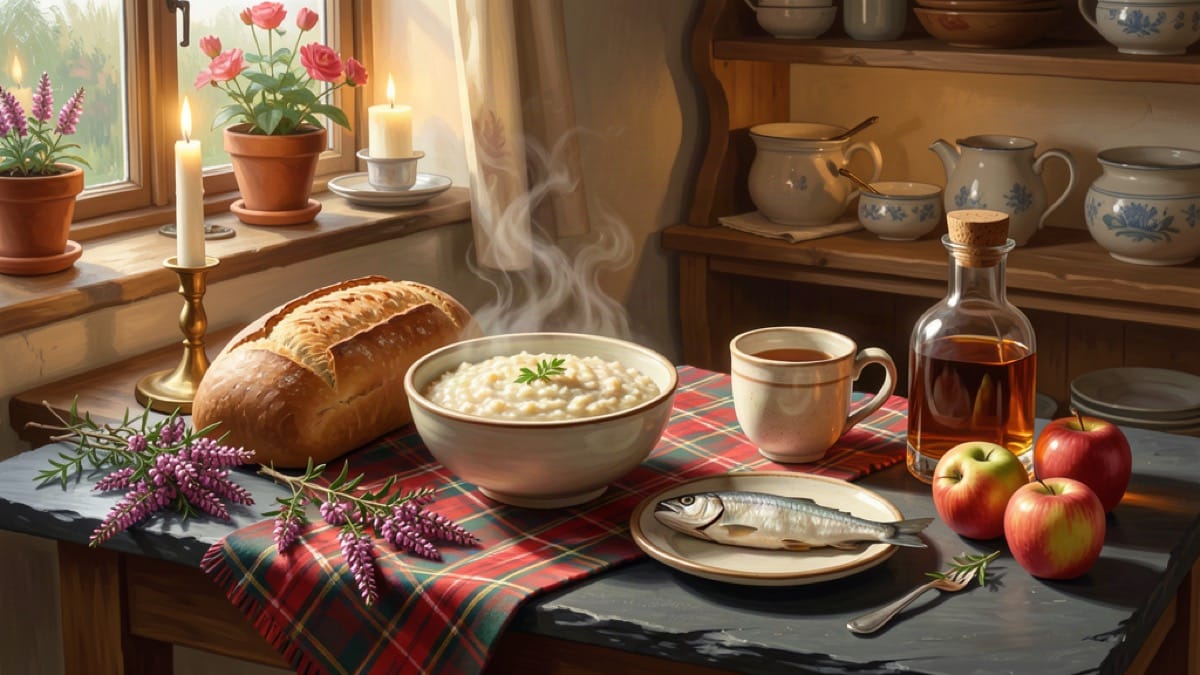
Porridge is brochan, and it holds an almost mythic place in the Scottish diet, traditionally tied to the Highlands and the weather. Bread is aran, and the Gaelic phrase for the staff of life appears in sayings about hospitality and survival. Knowing how to ask for brochan with milk and a spoon of honey is a perfect first breakfast conversation.
A learner practising food vocabulary should build sentences around meals rather than memorising isolated words. Talking about what is on the table, aran and brochan and a cup of taé, trains both the vocabulary and the natural rhythm of forming a Gaelic sentence.
Meat, fish and the sea
Scotland’s coastline names itself through food. Fish is iasg, and the herring that sustained coastal villages is sabhag, while the partan crab of the shores is partan. Asking for the catch of the day in a harbour town is a warm reminder that Gaelic was once the everyday language of fishing communities from the Hebrides to the northeast.
Meat is feòil, and the vocabulary around it fills the table with words for everyday cuts. Practising these words connects the learner to the land and the sea rather than to a supermarket, which is exactly how the language has always been spoken.
Fruit, vegetables and the sweet things
Fruit is meas, and the word repeats across the names of specific fruits in a way that helps a learner infer meaning. Vegetables are glazar, and alongside them sit the sweet things, from sugar, siùcar, to a piece of cake or a biscuit served with tea.
Building a shopping list in Gaelic, brèid meas and a bag of glazar, turns a mundane errand into a lesson. This is the essence of immersive learning: using the language for real tasks until it stops feeling like study and starts feeling like life. The everyday vocabulary sticks precisely because it is used in everyday contexts.
The pub and the toasts
The pub is taigh an taigh, literally the house of the drink, and it is the social heart of many Gaelic-speaking communities. Knowing how to order and how to respond to a toast is essential social fluency. The famous toast slàinte mhath, meaning good health, is the phrase every learner should have ready at the bar.
These phrases work because they are short, they are used constantly, and they carry clear social meaning. A learner who can raise a glass and say slàinte mhath has already connected with a community in a way that five pages of grammar never could. This is the social payoff that makes food and drink vocabulary so valuable.
Cooking verbs and the actions in the kitchen
Vocabulary is only half of a kitchen conversation; the other half is the actions. Scottish Gaelic has a small set of cooking verbs that every learner will meet: to eat is ith, to drink is òl, to make or cook is deanam, to boil is gòi, and to cut or carve is gearr. Putting a verb together with the food words turns a noun list into real sentences such as I will boil the potatoes or I am drinking the tea.
Practising verbs alongside the food nouns is what moves a learner from naming items to actually speaking about them. A useful exercise is to narrate a meal in Gaelic as it is prepared, saying the action and the ingredient together. This trains the natural pairing of verb and object, which is the heart of conversational fluency, and it keeps the kitchen, one of the most frequent rooms of daily life, firmly inside the learner’s active vocabulary.
Regional food and the heritage of the sea
The food vocabulary of Scottish Gaelic is inseparable from the places that produced it, and many regions still carry their identity through food. The herring fisheries of the northeast, the crofting traditions of the islands and the salmon rivers of the Highlands all speak their own version of the language through the table. Learning a few regional words, the partan of the shore, the herring of the harbours, the oat-based brochan of the glens, connects a learner to communities in a way that generic vocabulary never can.
This regional richness is also a reminder that Gaelic was, and in places still is, a living language of daily work and exchange. Knowing that the Gaelic world has its own food landscape helps a learner appreciate that they are not just learning words but joining a culture with a deep and practical history. Eating and drinking their way through the vocabulary is a respectful and enjoyable way to honour that heritage.
How to learn food vocabulary with spaced repetition
Food and drink words are perfect material for a spaced-repetition app because they are concrete, they are used every day, and they are easy to picture. An app that schedules reviews at growing intervals keeps each word in long-term memory, while a learner who only reads a menu translation will forget it by the next meal.
The strongest way to build these cards is with phrases from real situations: ordering a cup of tea, asking for the bill, offered a dram. Putting the whole exchange on the card trains the vocabulary inside its natural context, which is far more effective than drilling bare words. This is where a language-learning app built around spaced repetition genuinely shines, because it turns daily food vocabulary into durable knowledge with very little effort.
Common mistakes and practical tips
Beginners usually worry too much about perfect spelling and not enough about being shown the pattern of the language. Irish and Scottish Gaelic share roots, so a learner moving between the two will notice similar food words, which speeds up their progress. The best tip is to use food words in real moments: order in Gaelic when possible, name the items in the kitchen out loud, and listen to Gaelic media about cooking and the landscape. The LearnGaelic programme and the Am Faclair Beag dictionary are excellent free companions for checking exact pronunciations and regional forms.
None of this requires sudden courage, only consistency. Every time a learner says a food word out loud instead of just reading it, the word moves a step closer to being theirs. The language rewards the steady, daily accumulation of everyday words more than any dramatic but short-lived study session.
Conclusion
Scottish Gaelic food and drink vocabulary is the warmest introduction to the language because it is the language of welcome. From the first cup of taé to the final slàinte mhaith, these are the words spoken at the table where all of culture gathers. They are concrete, usable immediately, and deeply woven into the hospitality of Gaelic-speaking Scotland.
The most effective way to learn them is to practise with a spaced-repetition app that drills real phrases rather than isolated words, and to use them every day in real settings. Whether a learner reaches for a dedicated Gaelic app or a general language-learning app with built-in repetition, the principle stays the same: keep the words of the table in active rotation until they become habit.
A learner who can order a dram, ask for a cup of tea and toast good health has already done something remarkable: they have started speaking the language of Scottish welcome. That first conversation about food is often the moment a learner realises Gaelic is not a subject to pass but a life to live.